


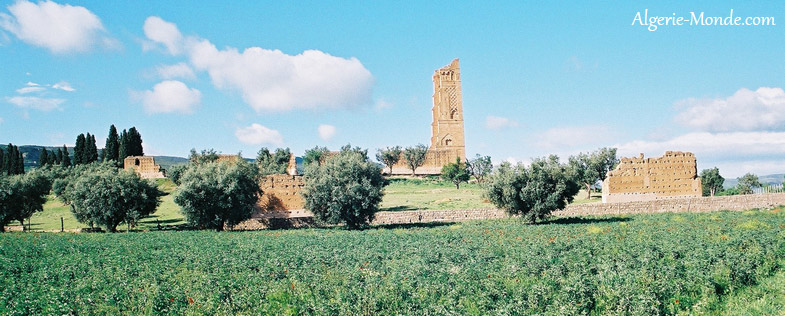
The Ruins of Mansourah, Tlemcen
The advent of Islam
The advent of Islam in the 7th century is one of the most significant events in the history of the Maghreb. In the year 681, with the arrival of Sidi-Okba, Algeria entered the history of Islam, because this new religion increasingly obtained the support of the population who participated in the conquest and Islamization of a large part of the Iberian Peninsula.
In the 3rd century of the Hegira, 9th century of our era, the entire North Africa was conquered by Islam. It was an unprecedented spiritual conquest.
The Rostemides
The political map of North Africa which goes from Tripolitania to the Atlantic Ocean, presents in the 9th century, the division that we still know. Three kingdoms juxtapose: Tunisia, Algeria and Morocco.
In the central Maghreb, Algeria is governed by the Rostemides dynasty, who reign in Tihert, near current Tiaret. To their ascetic simplicity, these Imams combine a taste for study and a scholarly culture. In Tihert, they assembled rich libraries and sent missions to the East to purchase manuscripts.
Science fascinates those around them: the women of their families devote themselves to the examination of dogma, Koranic exegesis, religious practices and Islamic jurisprudence. Other sciences captured their interest, in particular astronomy in the broad sense of the term.
The Fatimids
Muslim civilization reached its peak with the Fatimids who reigned for three centuries (from the 10th to the 12th centuries). The Kalaa of Beni-Hammad dates from this period. Built on a slope circumscribed by ravines, it is dominated by rocky heights which serve as an observatory and supply it with water.
Today, the minaret of the mosque stands in the middle of ruins where excavations have identified three palaces. The architecture of these residences is inspired by the Orient, Iraq and Persia. Hammadite art is a branch of Fatimid art.
Less refined than that of the Zairids, it nevertheless attests to a taste for luxury favored by the abundance of resources. The fall of the Kingdom of Kairouan channels towards the Kal'a of Beni-Hammad, the commercial and cultural current which will help the development of the Hammadites.
The Almoravids
It is in 1035 that the Almoravids will enter History. Guided by the Saharan Yousof, son of Tachfin, they took on a religious mission. Yousof left the most beautiful monuments of Muslim art in Algeria. At the first stage of his journey, he returned to Agadir where he founded Tagrart which would be his place of residence.
His modest palace would rather be an outbuilding of the Great Mosque. Tlemcen was only a stopover, the Almoravids captured Nédroma, Ténès, but did not go beyond Algiers.
The mosques are the most beautiful legacy of the Almoravids. The date of the construction of the Nedroma Mosque is attested by an inscription on cedar wood which crowned the Minbar. These remains are preserved at the Museum of Antiquities in the Parc de la Liberté in Algiers.
It is also the inscription of the pulpit which allows us to date the Great MOSQUE OF Algiers (1096). The architecture is inspired by that of the Great Mosque of Cordoba. In Nédroma as in Tlemcen and Algiers, Andalusian art exerts a great influence. For the Great Mosque of Tlemcen, Yousof wanted a simple building and this is how it appears to the visitor who enters the Mosque from the side face.
The architectural simplicity, where we recognize the austerity of the Saharan leader, contrasts with the decorative abundance of the central nave, later, with its ceilings with sculpted beams, the mirhab which is hollowed out in the back wall and the dome which precedes this niche.
An inscription on the cornice tells us that it was executed in 1136. The frame of the mirhab and the dome whose arches intersect and support openwork plaster panels are inspired by the Great Mosque of Cordoba. Added to this are elements of Hammadite art such as the stalactites which surmount the intersecting arches.
The Almohads
"The prosperity of the Almoravid kingdom was interrupted by the appearance of El-Mahdi, founder of the Almohad dynasty."
This is how Ibn El-Khaldoun introduced this new character who would change the course of the country's history. It was a turbulent time, when we were witnessing the end of the great Almoravid epic. At the end of the reign of Ali Ben Yousof in 1192, the Masmoûda already had formidable forces.
Heading towards the east, the Almohad troops commanded by Abd-El-Moûmin arrived at the mountains of Tlemcen. In Spain as in the Maghreb, the Almoravids were unable to resist the Almohads.
Only the "veiled men" who held the Balearic Islands escaped: the Béni Ghânya, who will play a significant role in the history of Algeria. Ibn Toûmert, known as El-Mahdi, was the precursor of the Almohad movement. Disciple of the theologian Ghazali, this reformer wants to apply the precepts of his master in the West.
Everywhere, he censors abuses and captivates listeners with his eloquence. It brings controversy to the field of theology while the Almoravids made jurisprudence their combat weapon. His supporters; the “Al-Muwahhidûn” (the Unitarians), professed the dogma of the unity of God in all its purity.
Algeria will take its place in history thanks to the role played by Abd El-Moumin, born in Nedroma. A great warrior leader, he led three campaigns which led to the unification of North Africa. From this time dates the first land register of North Africa: in 1159, Abd El-Moumin ordered the survey of Ifroquiya and the Maghreb.
We measured from Cyrenaique to Wadi N'oun, from length to width. A third of this area was subtracted for mountains, rivers, salt lakes, roads and deserts. The remaining two thirds were subject to the Kharadj or land tax.
This was a great innovation. The sovereign Almohads of the Maghreb enjoyed great prestige both in the East and in the West. However, the Almohad Empire, consumed by internal struggles for power and by the difficulty of governing such a vast empire, began its decline.
First it was Spain, which escaped the Almohad caliphate, followed by Tunisia (1236) with the Hafsids, Tlemcen (1239) with the Abd-Alwadides, Morocco (1269) with the Merinids, who took Marrakech. This was the end of the Almoravid dynasty. This is how the Berber Almohad dynasty reigned over North Africa and half of Spain from 1147 to 1269.