


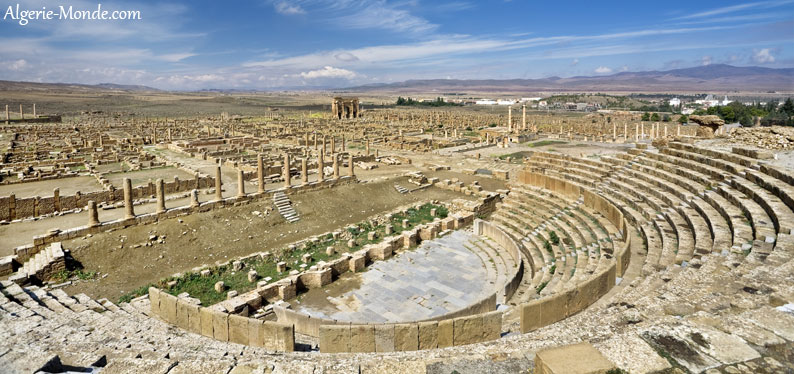
The Ruins of Timgad
The Roman occupation of North Africa, starting from Carthage, took place via three main axes:
- The first follows the coast of Tunisia from north to south, then it heads east and passes through Libya.
- The second, which goes from east to west, follows the line of the interior plateau, clearly behind the coastal massifs.
- The third, diagonally northeast and southwest, represents the route of penetration towards the southern border and towards the Aures through Ammaedara (Haïdra, Tunisia), Thevesti (Tebessa), Thamugadi (Timgad), and finally Lambaesis (Lambèse).
Three of these cities were the bases of the Roman legion, which occupied Ammaedara under the reign of Augustus. In the year 75, it settled in Thevesti, in 81 in Lambaesis, which subsequently became its permanent seat before being the capital of Numidia.
Numidia is not a coastal province like Ifriqia with Carthage and Mauretania with Caesarea, but an inland province, facing the desert, concerned with defending the African provinces against the dangers that would come from the south.
Numidia is a military territory, whose command is installed in Lambèse, it will become an independent province of the Proconsullaire in 198. From 126, routes of penetration will help it to progress along the tracks of the South, but it narrows towards the north: Hippo Régius (Hippone) is in Proconsullaire, Igilgili (Jijel) in Setifian Mauretania.
The coast of Numidia has two ports: Rusicade (Skikda) and Chullu (Collo). The rest of Algeria forms Caesarian Mauretania. Mauretania was governed from Caesarea (Cherchell). Its border is more southerly, far from the Hondna mountains and the Oran high plains, it hardly penetrates more than 100 km from the sea.
Beyond this coastal strip, the Numidian populations continue to follow their way of life and to fight against the Roman occupation. The Roman cities in Numidia and Mauretania were built on the Roman cities in Numidia, some of which experienced great growth and enjoyed great fame in these ancient countries. Hippo, Cuicul, Tiddis, Thevesli, Madouros, Tipaza, Siga, Ténès and probably the most important Roman cities were based on the Numidian cities themselves, founded along the coast, on the site of the Phoenician trading posts.
The most important ruins of Roman cities are found in the east of Caesarian Mauretania, in the Aures and in the north of Numidia. If sedentarization took place at the time of the Phoenicians and the Numidian Kingdoms, it is urbanization which will constitute the basis of the Roman Empire.
The number and monumental splendor of Roman cities revealed by the imposing ruins of Timgad, Lambèse, Djemila-Cuicul, Tiddis, Tipaza bear witness to the role played by African cities.
In the world, only two cities remain intact and bear witness to the urban perfection of Roman cities: Pompeii, in Italy, buried and preserved by the ashes of Vesuvius and Timgad in Algeria, buried and protected by desert sand.
The methodical plan of Timgad, with its regular grid, seeks to introduce itself everywhere, on the rump of the Numidian city of Cuicul-Djemila, on the slope of Tiddis, above the capricious layout of the Punic and Numidian city of Hippone la Royale.
The two main streets intersect at right angles. The others are parallel to them. Near the central crossroads, the Forum is a closed, isolated square, inaccessible to cars, surrounded by a portico flanked by a judicial basilica. The square, decorated with statues, is the political center.
The theater is often close to it. In Timgad, the whole town seems to be based on the hill, where it was possible to dig the "cavea". The amphitheater and circus are often located in outlying neighborhoods or in the suburbs. In the paved streets, often lined with porticos, we find temples, markets and thermal baths.
Secondary squares make it possible to create new architectural ensembles. At the crossroads stand monumental fountains or nymphaea fed by aqueducts which, crossing the mountains by tunnels, crossing the valleys by arches, bring pure and abundant water from very far away.
By visiting the Timgad Museum, one is struck by the splendor of the mosaics where geometric motifs and scrolls blossom into foliage of unknown delicacy and exuberance. Each city had its decorators and mosaicists.
The difference in style between these schools reveals the vitality of the local workshops. No pavement, in the entire Roman world, can be compared to the mosaic of the grape harvest. No analogy, either, to the hunting mosaic of Hippo.
We can conclude that the Romans did not import fixed models or fixed forms into Africa. They let the Africans work in their own way, establish their city according to their own genius, distribute monuments as they wished, the shapes of which they adapted, according to the terrain, according to their convenience, according to their taste.
The Numidians, through their creative genius, perpetuated the work of their ancient kings. The prosperity of the Roman city is due to agriculture. We can list at length the industrial activities developed at this time, but it is the soil that sustains Africa. Hunting, even primitive, remains an industry. Specialists tag lions and panthers for circus games.
Livestock development develops, shepherds raise Western-style sheep. The Numidian horses, the Barbes, small and robust, remained popular and were used as auxiliary cavalry. At that time, Algeria was above all a country of culture. “It’s the attic of Rome.”
Vine and olive plantations are developing. From millstones to presses, we will arrive at enormous factories like that of Tébessa-Khallia, whose ruins bear witness to the intensive nature of the culture. During this period, Algeria produced and exported cereals, oil, wine, marble from its quarries, wild animals from its forests.
Saint Augustine
Saint Augustine, born in Tagaste (Souk-Ahras), 354-430, is the most famous of the Fathers of the Latin Church and the greatest spirit of the first centuries of Christianity in the West.
Bishop of Hippo, from 396, he died in the city besieged by the Vandals. The influence of Saint Augustine is undoubtedly that which has most marked theology of all time, because his work has something universal.
All his thought is centered on two essential problems: God and the destiny of man. But there are also these men who never stopped fighting against the economic, cultural and religious domination of the Romans and who left their names engraved in history.
Firmus
Firmus, Berber prince who died in 375. Son of King Nubel, he stood up against the vexations of the Roman governors; in 372 he raised the tribes of Djurdjura against Rome and was proclaimed king. He took Cherchell, but failed before Tipaza.
However, he resisted the Romans for three more years. Persecuted in the Atlas regions, Firmus hanged himself so as not to fall into the hands of the Romans. Donat, Optat and other Christian bishops also formulated demands that went beyond the strictly religious framework.