


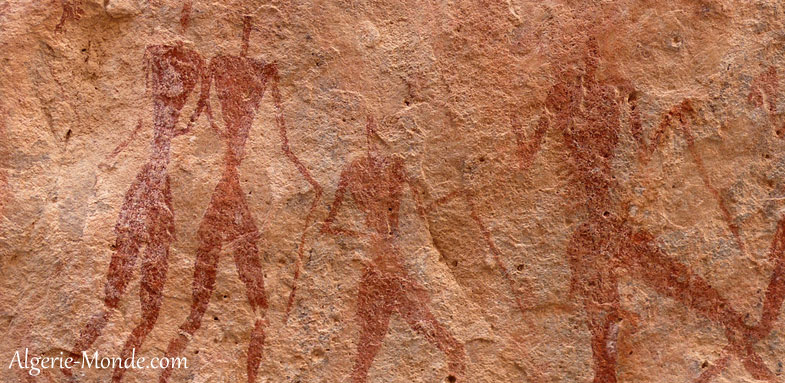
Rock painting at Tassili n'Ajjer
Algeria has been populated since the dawn of time. The remains of human presence in Algeria date back 400,000 years, an age attributed to the remains of "Atlanthropus", discovered in the sediments of the prehistoric Lake Ternifine, in Orania.
Atlanthropus was a contemporary, and a relative, of Simanthropus and Pithecanthropus of Java. Bones were found among the cut stone tools he made. Tools of the same type have been found on other sites attesting to the presence of primitive man.
At this time, Algeria was populated by elephants, certain species of which persisted until historic times, but also rhinoceroses, warthogs, hippos, giraffes, hartebeests... "These are the banks of Chad and the Zambezi, transported in the Maghreb and in the heart of the Sahara, it is a landscape of tropical savannahs, perennial wadis, lakes and marshes in which the civilizations of the Lower Paleolithic took place. The Capsian civilization is located around the 7th millennium BC. Capsians are the first men of our species to appear in North Africa.
This type of Homo-Sapiens lived in camps made of huts and branches. Leaving from the south of Continent, the Capsians follow the line of the Chotts, and spread throughout the Maghreb. They can be considered the ancestors of the Numidians, but they will not cross the Tellian Atlas.
The coast was occupied at this time by Iberomaurissians, related to the Cromagnon type. Despite their low level of culture, they adapted to Neolithic civilization like the Capsians. Gradually repressed, they nevertheless persisted until historical times. The Capsians, for their part, adopted Neolithic industries and kept their form of life.
In Algeria, we witness, in a striking way, the immediate proximity of history and prehistory. Herodotus and Salustus bear witness to the North African forms of Neolithic civilization. It must be emphasized that it is in the Sahara that the Neolithic civilization was to experience its greatest successes.
Whether it is paintings from Tassili-N'Ajjers, and Tassili du Hoggar, whether it is cut and polished stones, as we can see in the magnificent collection of the Bardo Museum, we discover completed works of astonishing technical perfection.
And the frescoes if important on a documentary level, testify to the artistic taste of the Saharans of Prehistory. Certain sculpted and smoothed stones, which represent animals, bovids or gazelles, have an astonishing evocative power.