


A palm garden is not simply a natural refuge in an otherwise empty desert. It is also the result of knowledge, decisions and continuing work. A fortified settlement expresses relationships between households and community; a song may carry language and memory; a rock painting can reveal a landscape unlike the one around it today. Reading these connections makes a Sahara journey richer, while reminding us that heritage belongs to people whose lives extend beyond a visitor’s itinerary.
Begin with differences, not a single desert culture
The places in this collection share a Saharan setting without sharing one uniform history or way of life. Gourara’s Ahellil, the M’Zab’s Ibadi settlement heritage, the Kel Ajjer context of Djanet and the agricultural knowledge of the Souf are distinct subjects. Connecting them can be illuminating; merging them into a generic account of desert people obscures what a visit might actually teach.
The same applies to landscape. Sandstone formations, mountain country, dune edges and cultivated depressions invite different explanations. Start with what is present rather than an expected image: how is the ground shaped, where does cultivation occur, and how do people move between home and work? A good guide helps link those observations with local terms and experience, while leaving room for differences between neighbouring places and individual accounts.
Foggara heritage includes the people who measure water
UNESCO’s intangible-heritage inscription concerns the knowledge and skills of foggara water measurers in Touat and Tidikelt. Its focus is not simply an old channel or an attractive distribution structure. Water measurers calculate shares, maintain distribution combs and help direct water, working within a system that also involves owners, workers and people responsible for accounts. The material system and its social organisation need one another.
This distinction changes how to approach a water-related visit. Ask how allocation is understood and who holds the knowledge needed to maintain it, not only where a channel begins. It also prevents a geographical mistake: the inscription does not designate Timimoun or all Gourara foggaras as UNESCO sites. Use it to understand a particular body of knowledge, without extending its scope to every oasis water system you encounter.
The ghout brings roots towards groundwater
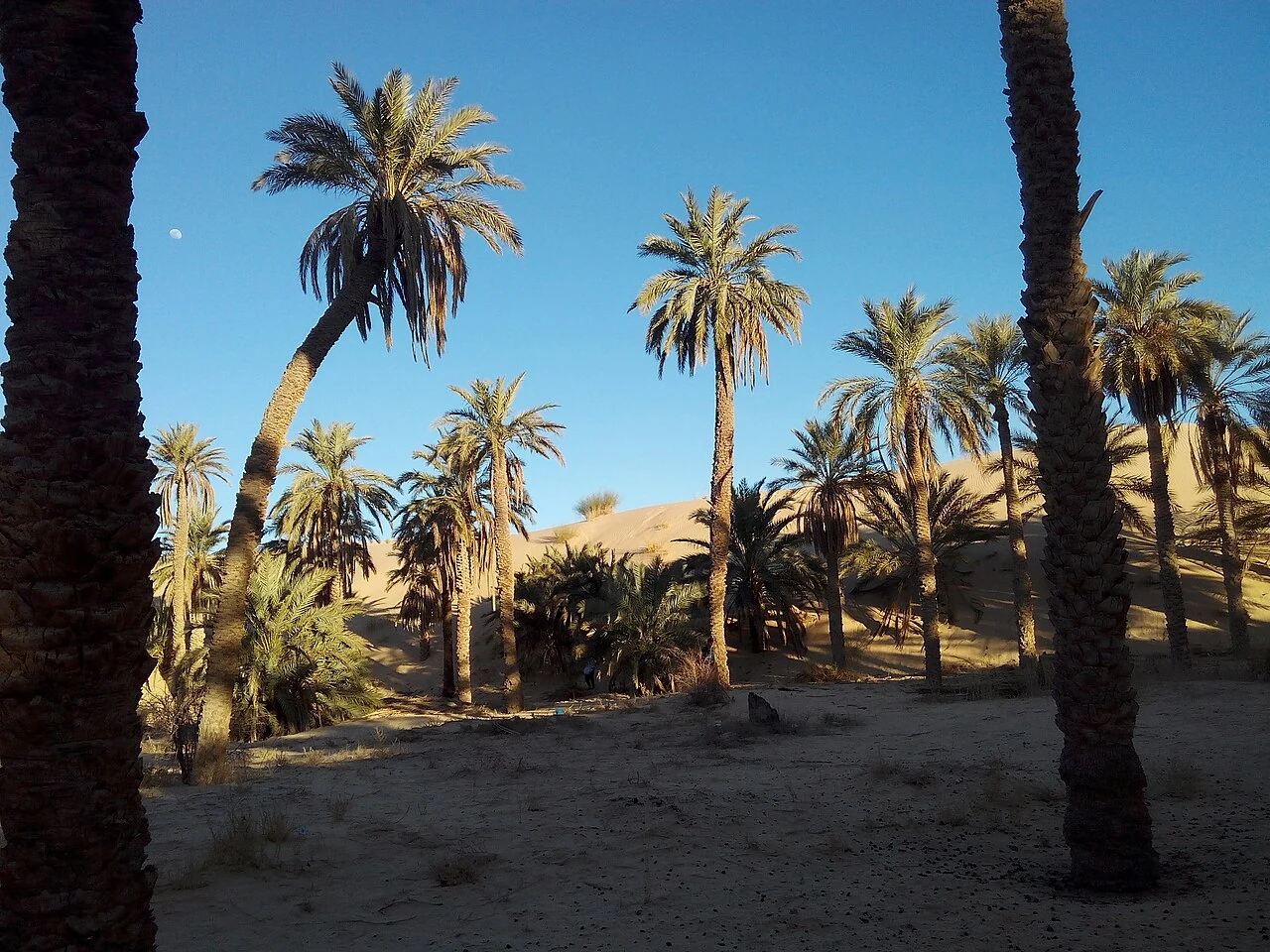
The Souf’s traditional ghout offers a different principle. FAO describes depressions dug so that date-palm roots can reach groundwater nearby, rather than depending on pumping that water to a surface-level planting area. Farmers use knowledge of wind in shaping and maintaining the garden, with palm-leaf windbreaks and regular sand removal. The hollow is therefore both an agricultural space and a record of environmental understanding.
Palms can form the upper level of a cultivated system that also includes fruit trees and vegetables. Yet this is not a picture of effortless abundance: FAO identifies groundwater pumping and drainage disturbances among the threats. Describe the ghout as a living agricultural system, recognised by FAO’s Globally Important Agricultural Heritage Systems programme, not as a UNESCO World Heritage monument or a universal model used identically across the Sahara.
In the M’Zab, architecture extends beyond the walls
The M’Zab Valley’s five historic ksour are El Atteuf, Bounoura, Melika, Ghardaia and Beni Isguen. UNESCO connects their architecture with Ibadi community life, family privacy and adaptation to the environment. Its account of mosques, surrounding houses and defensive boundaries gives a visitor a framework for understanding form through purpose, rather than regarding the settlements as arrangements of picturesque shapes.
The heritage landscape also includes cemeteries, palm groves and associated summer settlements, together with water capture and distribution. A street walk is therefore only part of the picture. Where a complementary visit is appropriate, notice how built and cultivated spaces relate. Above all, let the emphasis on family privacy guide your own behaviour: a doorway, roofline or quiet lane is not automatically a public invitation simply because it belongs to a celebrated heritage place.
Rock art is evidence, not a story with every answer supplied
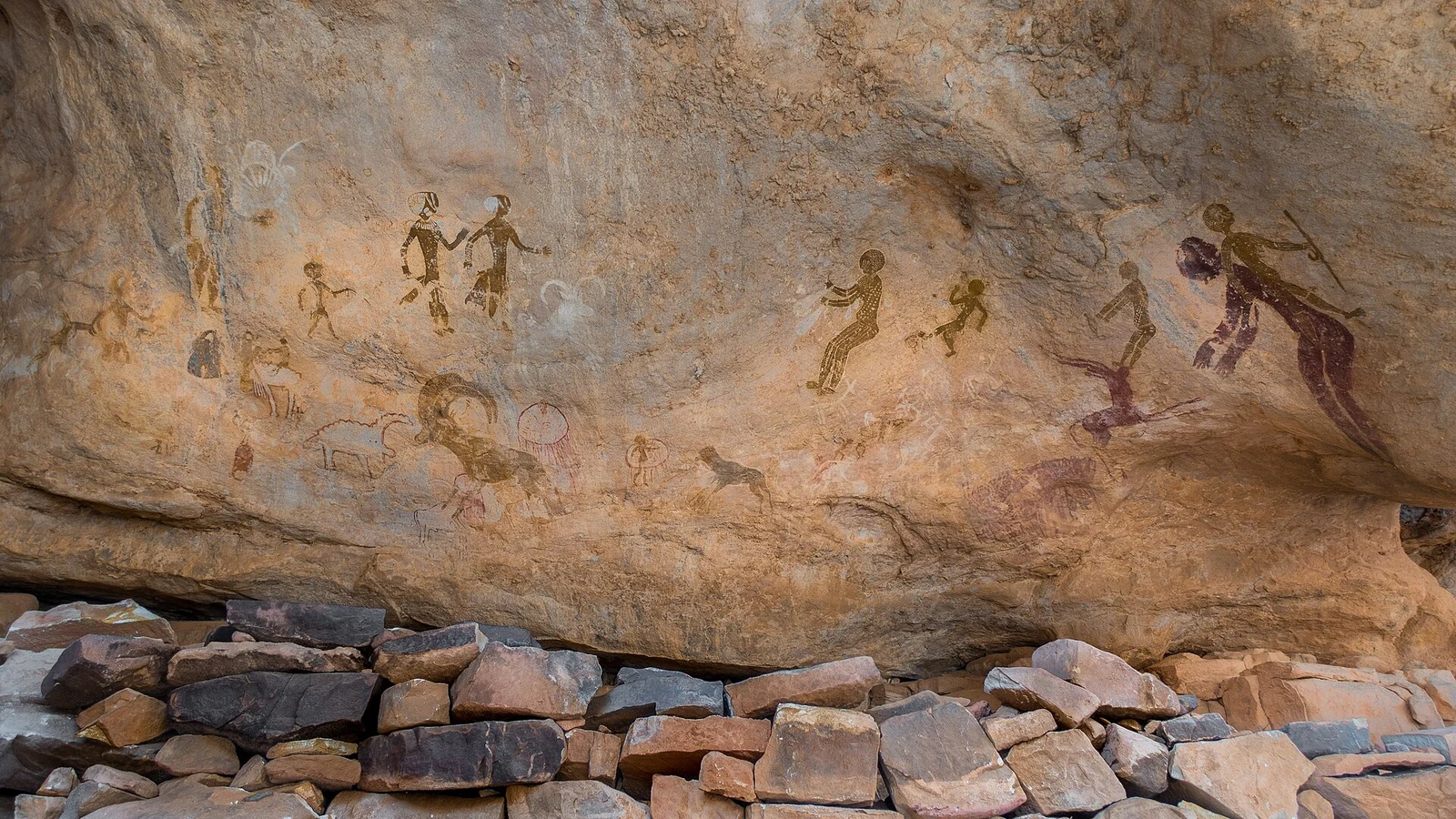
Tassili n’Ajjer brings geological and cultural histories together. UNESCO describes eroded sandstone formations and paintings and engravings that register changes in climate, animals and human life. Images of pastoral activity and water-dependent animals open a view onto environments different from the present one. That is a more substantial reason to visit than the idea of finding an untouched landscape outside history.
Look at what the image allows you to say and what remains interpretation. A recognisable animal does not make every associated figure or gesture self-explanatory. Ask guides to distinguish established context, local accounts and uncertainty. Preserve the evidence by leaving surfaces untouched: no water to strengthen colour, no tracing, no leaning for a photograph and no collecting nearby objects. Protecting a panel includes protecting its setting, not just the most visible figures.
Allow people a present as well as a heritage
Heritage writing often uses the past tense so comfortably that it makes living people disappear. A resident of an oasis town, a Tuareg guide, an Ibadi household or a grower maintaining a ghout also has contemporary work, preferences and choices. Dress, language or occupation cannot tell a visitor everything about someone’s identity, and no individual should be expected to represent an entire community.
Be curious about continuity and change together. A repaired building or an adapted tool may reveal the effort of keeping something useful, not a loss of authenticity. Ask open questions and accept that private matters can remain private. A meaningful encounter depends less on entering a home or seeing a ceremony than on allowing the person receiving you to decide what they want to share.
Ahellil is a shared practice, not background sound
Ahellil, associated with the Zenete communities of Gourara, combines poetry, polyphonic singing, music and dance. UNESCO describes a singer and flute player with a chorus standing together in a moving circle. The tradition belongs to collective occasions and carries connections to language, community history and oasis life. Knowing that context changes the experience of listening: the social relationships are part of the art.
UNESCO also identifies pressures on participation and transmission, including fewer occasions for performance and a preference for recordings over active involvement. If an appropriate live encounter is available, respect its setting and the performers’ terms. Ask before recording, distinguish listening from permission to publish, and do not demand that a religious or family occasion become a tourist programme. A recording can introduce the sound, but it cannot substitute for the practice that sustains it.
Ask about making, use and repair
Craft becomes more interesting when an object is understood as the result of decisions. Ask who made it, which materials were used, how long particular stages take and what the object is intended to do. If you encounter similar pieces in different places, do not assume they were all produced locally. Trade is part of everyday life too; honest provenance is more useful than a reassuring label.
Look at finishing, joins, texture and the possibility of repair rather than rely on an elaborate story about a symbol. Pay for work and arranged demonstrations fairly, and ask permission before filming a technique. Avoid archaeological objects, fragments or anything presented as removed from a protected site. An uncertain claim that an item is old should prompt caution, not make it more desirable as a souvenir.
Let meals explain the place without inventing a single cuisine
The relationship between oasis cultivation and food is especially clear in the Souf, where FAO describes date palms alongside other crops and knowledge of conserving and processing dates. Elsewhere, the most reliable starting point is the meal actually offered. Ask about ingredients, preparation and where produce comes from, rather than assuming that every dish expresses a fixed recipe shared across the whole Sahara.
A market visit can help distinguish locally grown foods from goods brought through trade. Availability, family preference and the setting of a meal all matter. Explain allergies and dietary needs in advance, and allow a host to say that a particular request cannot be met. An invitation to taste is not permission to enter a kitchen, photograph a family table or publish someone’s recipe without asking.
Make recognition a reason for care, not entitlement
World Heritage, intangible cultural heritage and agricultural heritage recognise different kinds of value. None is an all-purpose ticket, a promise of opening hours or evidence that a site is suitable for every visitor. Check local arrangements, pay for appropriate expertise and accept that a restricted visit can still be informative. A carefully explained exterior may be more respectful and more useful than access obtained through pressure.
Direct curiosity towards what keeps a place viable: transmission of knowledge, maintenance, meaningful work and decisions made by the people concerned. Keep water infrastructure and gardens undisturbed, leave rock art and archaeological material where they are, and remove your own waste. The aim is not to leave with a complete explanation of the Sahara, but with better distinctions, better questions and a more accurate account of the places that welcomed you.

