


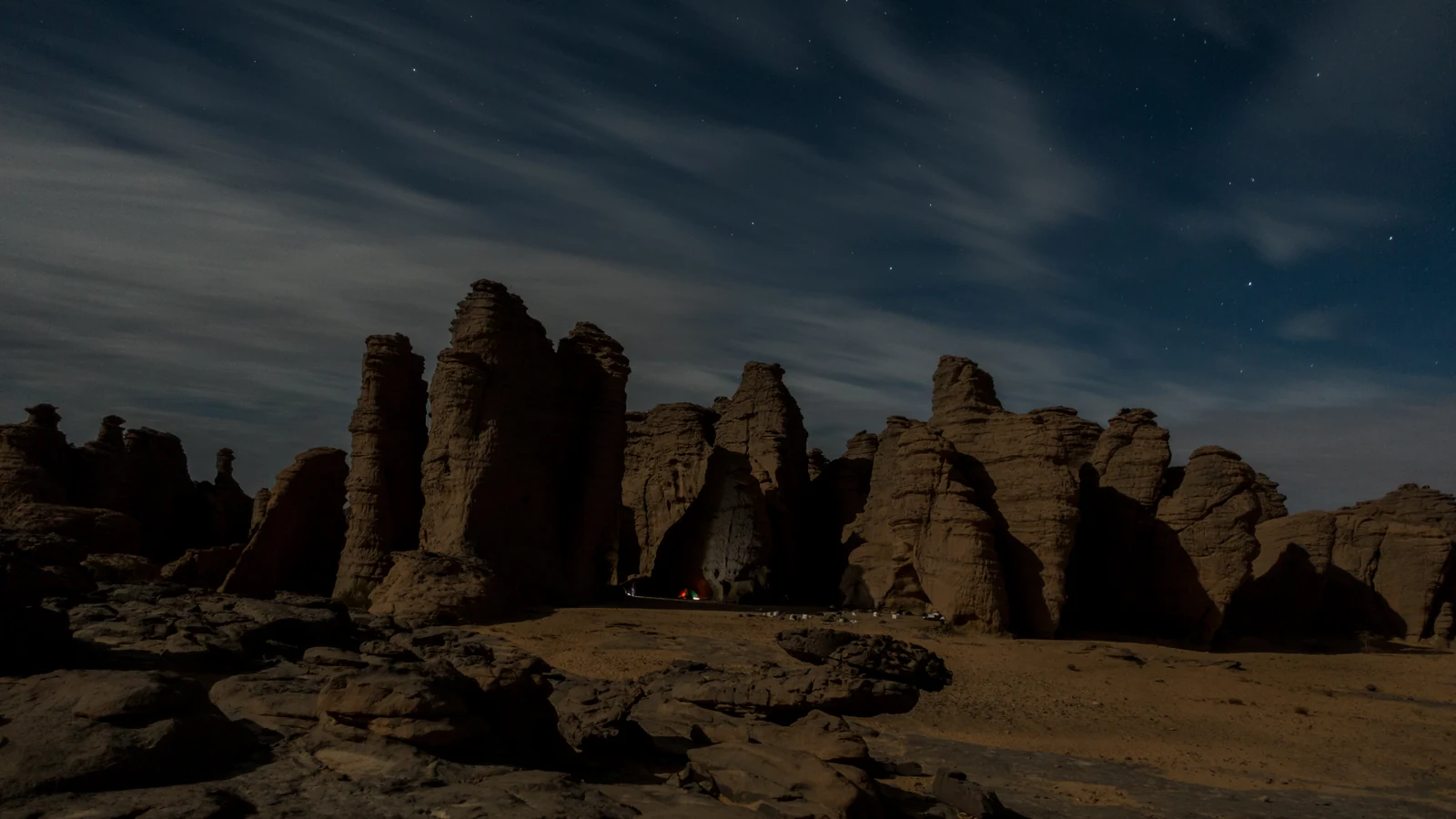
Planning the Sahara is not mainly an exercise in buying specialist equipment. It is a sequence of decisions about where to go, how to travel and what support you need. An architectural stay in the M’Zab, a ghout visit around El Oued, a plateau walk near Djanet and a mountain circuit from Tamanrasset place very different demands on a traveller. Start with those differences; practical preparation then becomes much more specific and useful.
Choose an experience before drawing a long route
Write down what would make the journey worthwhile: sustained walking, rock art, mountain scenery, oasis cultivation, architecture or time with local makers. Choose a main region that serves that interest. Djanet’s plateau and Tadrart possibilities need distinguishing from one another; the Ahaggar is a separate mountain proposition. Gourara, Saoura, the M’Zab and Souf are not interchangeable alternatives merely because each has oasis connections.
Build outward from a plausible base, not inward from a list of famous names. Ask how much of each day would be spent moving and how much would remain for your main interest. If combining regions consumes the time you wanted to spend exploring them, remove a region. A coherent journey is usually more satisfying than an itinerary whose greatest achievement is its length.
Compare conditions, not a single best-season slogan
For an outdoor-focused trip, investigate the cooler part of the year first, but assess your actual route rather than rely on a broad season label. Mountain exposure around Assekrem is not the same as an oasis street walk. Daytime comfort does not establish overnight comfort, and a pleasant forecast at the arrival town does not describe every higher or more remote stop.
Summer heat can make exposed activities unsuitable; winter can bring cold and difficult conditions of its own. Wind and rain can also change plans. Ask the operator how timing, walking and overnight locations would adapt, and what would lead to cancellation rather than modification. No season guarantees safety. Review the forecast close to departure and keep enough flexibility to act on updated local advice.
Separate entry to Algeria from access to a route
Check entry requirements with the Algerian consular authority responsible for your nationality and circumstances. Establish what documents, visa process or other permissions apply before buying inflexible arrangements. If a tour company offers help, ask exactly what it provides and what remains your responsibility. A booking confirmation, an invitation and permission to enter are not interchangeable documents.
Then check the proposed journey within Algeria. UNESCO describes Tassili visitor groups as accompanied by official guides, but that does not supply the current procedure for every route elsewhere. Ask who obtains any necessary local permissions and when confirmation will be available. Official advice identifies terrorism and kidnapping risks, including in remote and border desert areas. Read the full regional advice and map applicable to your circumstances; an operator’s willingness to sell a trip is not official clearance.
Build connections with room for disruption
Confirm every arrival point, transfer and onward connection directly with the providers involved. If flying, verify the actual airport, operating date, baggage rules and arrangements if a service changes. Do not build a desert departure on an assumed flight pattern or an old timetable. For road transfers, ask about the vehicle, driver, stops and whether travel after dark forms part of the proposal.
Allow a margin between a remote excursion and an essential onward connection. Make the pickup location unambiguous and keep the organiser’s contact details available offline. Official advice notes that mobile coverage and digital maps can be unreliable in remote areas. An offline map can help with orientation, but it does not replace route knowledge, a suitable vehicle or current permission to travel.
Compare the substance behind the itinerary
Ask prospective operators for a written description of named stages, guiding, transport, accommodation and inclusions. Find out who will actually accompany you, what language they can use for detailed explanations and how the team handles changes. A long list of sites is less valuable than a clear account of what happens between them, including rest, meals and time to walk.
Discuss communications, vehicle problems and the process for reaching assistance. Ask how the group’s location and plans are shared with someone outside the travelling team. Request cancellation and refund terms, including what happens if access restrictions prevent the main activity. These are not adversarial questions: they help distinguish a well-matched proposal from one that is attractive but too vague to assess.
Define what a bivouac includes
Bivouac describes an overnight style, not a uniform standard of comfort. Establish whether tents, sleeping mats, sleeping bags or blankets are supplied and what condition they are in. Ask about shelter in wind or rain, privacy, toilets, washing arrangements and where people change clothes. Clarify whether sleeping outside is optional and what alternative exists if the conditions or your needs change.
Discuss meals and drinking-water provision before departure, particularly allergies or dietary restrictions that require reliable separation or specific ingredients. Ask how water and food are stored and how waste is removed. The team should select an appropriate camp for terrain and weather, not simply the most dramatic view. A dry channel is not automatically a suitable overnight place; official advice documents serious flood hazards in Algeria.
Pack for the proposed days and nights
Choose footwear for the actual surface and break it in before travel. Bring adjustable clothing, sun protection and a dependable light, with enough insulation for the forecast at the overnight locations. Separate the small bag needed while walking from the luggage travelling with the vehicle. Confirm how much you must carry and what can remain with the team.
Carry essential medication and relevant documents where you can reach them, protect electronics from sand and keep a modest charging plan. Check customs rules before packing drones, binoculars, telescopes or specialist camera equipment: official advice warns that authorisation may be required. Do not assume a familiar outdoor or photographic item is unrestricted because you have taken it elsewhere. Avoid packing elaborate equipment whose use has not been agreed.
Match support and cover to the actual activities
If you have a medical condition, seek suitable pre-travel advice and explain practical needs to the organiser before committing. Discuss the expected exertion, time away from facilities, food requirements and any difficulty with heat, cold or rough travel. Ask where professional assistance could realistically be reached from each stage; do not accept the word nearby without a route-specific explanation.
Check insurance for the exact geographical area, official-advice status, activities and any relevant altitude or remote-travel conditions. Ask the insurer directly about medical treatment, evacuation, interruption and exclusions, and keep its assistance procedure offline. A guide or driver cannot guarantee rapid rescue. Agree on the signs or circumstances that would end an excursion, including when a traveller simply cannot continue comfortably.
Compare like-for-like costs without false precision
Request itemised quotations rather than use a universal daily-budget figure. Compare guiding, vehicle and fuel, transfers, rooms or camp equipment, meals, drinking water and any locally arranged visits. Establish whether the price is per person or for the whole group, and which costs change if the group size changes. The cheapest headline can hide a materially different level of support.
Keep a contingency for itinerary changes and ask how payments, deposits and refunds are handled. Discuss cash needs and where payment facilities can actually be relied on, without carrying more than is sensible. Separate optional purchases and gratuities from required charges, and ask how a hosted visit compensates the people receiving you. A transparent budget also makes expectations within the group easier to manage.
Describe needs instead of accepting broad labels
For children, older travellers or anyone with an access need, assess individual stages rather than ask whether the Sahara is family-friendly or accessible. Request details about vehicle entry, appropriate child restraints, seating, toilets, gradients, steps, sand, shade and the longest period without a comfortable break. Ask whether the party can shorten an outing without disrupting everyone else’s return.
Photographs of accommodation and a specific route description are more useful than reassurance. Discuss sleep, food routines, privacy and the ability to rest during the day. A town-based stay with carefully selected excursions may fit better than a remote camp, but it still needs checking. Do not let an attractive destination override a clear mismatch between the available support and someone’s needs.
Finish with a shared, workable plan
Before departure, review the final itinerary with everyone travelling: confirmed services, pending permissions, baggage arrangements, payment terms and fallback options. Give a trusted contact the relevant itinerary and organiser details. Save documents and essential numbers offline. Recheck official travel advice and forecast conditions, then ask the operator whether anything has changed since the proposal was prepared.
Leave room for enjoyment rather than schedule every pause. A well-prepared journey creates time to listen in a palm garden, study a rock-art panel or stay with a changing mountain view. Its success lies not in eliminating uncertainty, which no organiser can promise, but in knowing which decisions have been made, which conditions still matter and how the group will respond if plans change.

