


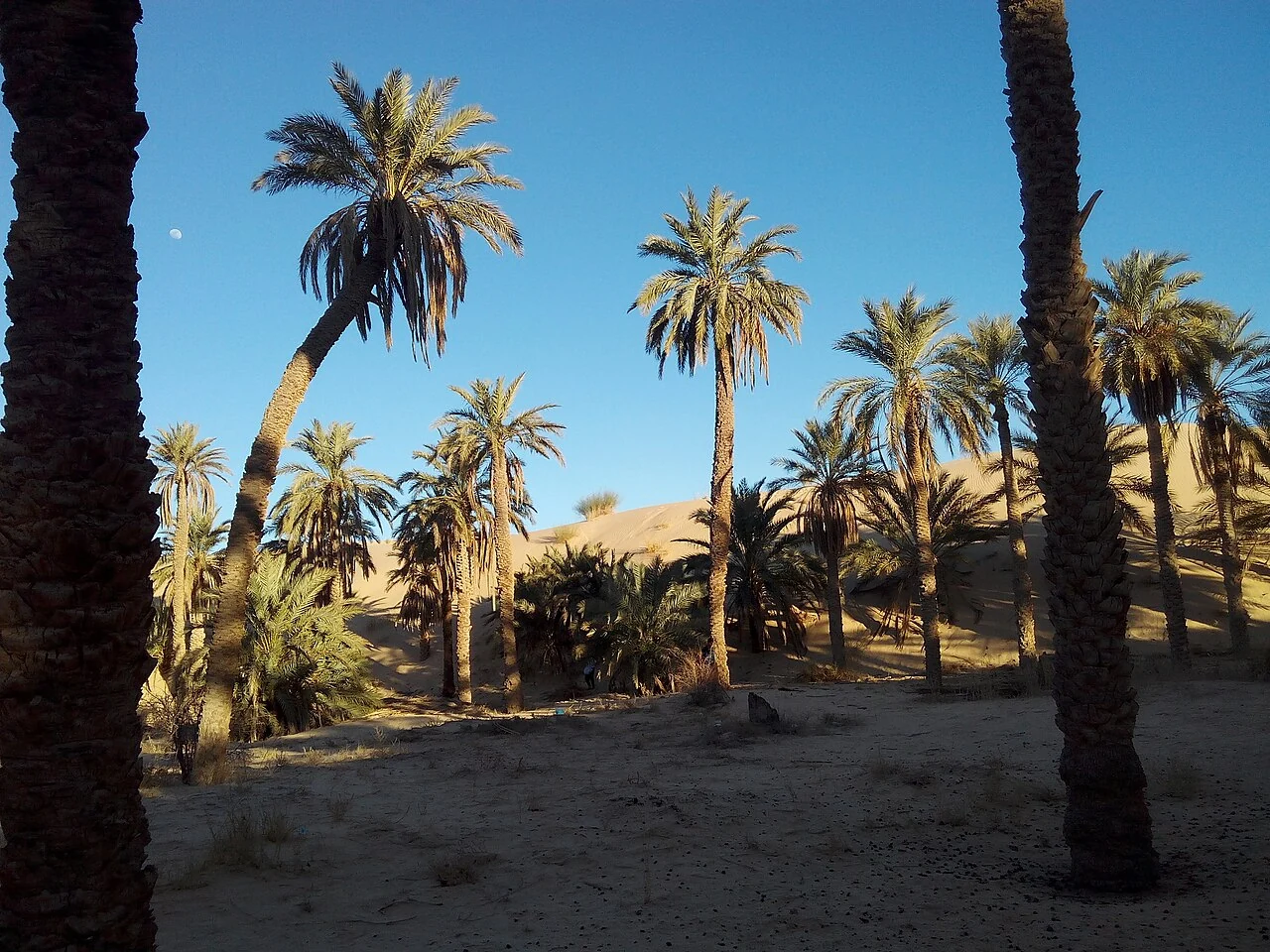
The Souf offers a different way to read an oasis. Instead of beginning with a channel carrying water towards a garden, begin with the level at which the garden is planted. In the traditional ghout system, cultivated depressions bring date-palm roots close to groundwater. This simple distinction changes what you notice: the shape of the ground, the handling of windblown sand and the skill needed to keep a productive place working.
Connect El Oued with its agricultural surroundings
El Oued is the urban starting point for exploring the Souf, while the ghout is an agricultural system rather than a single monument in town. FAO recognises the Ghout Oasis system of El Oued within its Globally Important Agricultural Heritage Systems programme. That recognition concerns a living relationship between cultivation, environmental knowledge and livelihoods; it is not a guarantee of visitor access to every garden.
Plan a stay with both an urban and an agricultural dimension. A town walk introduces the place where people live, trade and work today. A separately arranged grower-led visit can explain the surrounding cultivated landscape. Neither needs to be treated as a brief interval before another drive into sand.
Understand the principle: lower the planting level
FAO describes the traditional ghout as a depression dug into the sand so that date palms can be planted near the groundwater. The palm roots reach the water resource because of that proximity. This is the crucial idea: the traditional system should not be reduced to a generic well that pumps water onto a surface-level garden.
At a permitted visit, first look at the relationship between the rim, the planted ground and the palms. Ask the grower to explain the particular site rather than infer underground conditions from appearance. The visible depth alone cannot tell a visitor how the water behaves, and a present-day plot may combine practices that need their own explanation.
Notice the work that keeps the shape intact
The form of a ghout is not maintained by excavation alone. FAO describes knowledge of wind direction and speed, the use of palm-leaf windbreaks and the repeated removal of sand. A garden that appears settled and quiet therefore records continuing effort. The space between cultivation and surrounding sand is an actively managed boundary, not a naturally fixed edge.
Ask which tasks are under way and whether the host is willing to demonstrate a tool or explain a technique. Stand where directed so that the visit does not damage plants or unstable margins. A detailed account of maintaining one part of the garden may teach more than a hurried tour of many depressions with no one to interpret them.
Keep ingenuity and vulnerability in the same picture
The ghout is an ingenious adaptation, but it should not be described as a system beyond environmental pressure. FAO identifies groundwater pumping and drainage problems as threats, with both drying and unsuitable water conditions affecting gardens. That makes water balance a more useful theme than a reassuring claim that traditional methods automatically solve every present-day problem.
Ask how the particular grower understands changes at their site and what work is needed to keep it productive. Listen without turning a local account into a universal conclusion about the whole Souf. Avoid intrusive questions about income or ownership unless the host raises them, and do not treat an abandoned-looking plot as open ground for exploring.
Look at the domes without reducing the city to them
El Oued is widely associated with its domed roofs. They offer a distinctive architectural subject, but a useful town walk should connect roofscape with streets, trade and contemporary building rather than search only for a perfectly uniform old view. Ask a local guide which buildings can be understood from public space and which explanations of their construction are well established.
If a higher viewpoint is suggested, confirm that it is legitimately open and that photography does not intrude on homes. Looking from street level can be equally rewarding: notice how the outline of a dome changes as you move and how different buildings sit alongside one another. Modern additions belong to the city’s present life, not to a mistake in your composition.
Follow the palm into food and useful objects
Date palms are central to the ghout, but FAO also describes a multilayered system with fruit trees and vegetables cultivated beneath them. Ask what is growing at the time of your visit and how different spaces are used. Do not assume that every garden has an identical crop mix or that a particular product will be available in every season.
The agricultural heritage account also links plant resources with local craft and the preservation and processing of dates. At a shop or hosted visit, ask about the origin and practical use of what is offered. Tasting can be a good introduction when invited; dietary needs, allergies and any conditions for taking food across borders still deserve attention.
Give the garden visit the better part of your attention
For an editorial itinerary, begin with an introduction to El Oued and arrange a separate, unhurried agricultural visit at a time suitable for the host and conditions. Follow it with a meal or market stop that lets you connect the explanation to everyday products. This sequence is a way to organise interests, not a pre-booked excursion or a promise of farm access.
Leave space to adapt. A grower may have work that cannot wait, and a replacement activity should not require uninvited entry elsewhere. Ask the organiser to explain who has agreed to receive you, what the visit includes and how the host’s time is compensated. These details distinguish a genuine meeting from simply stopping beside cultivated land.
Ask about the descent, the return and the shade
A ghout visit may be quite different from a level urban walk. Ask whether the plan involves descending into a depression, moving over soft sand or standing outside for a prolonged explanation. Request specific information about gradients, stable footing, shade and toilets. For anyone with limited mobility, a suitably chosen upper viewpoint might be an alternative, but it must be assessed locally.
Prepare clothing and drinking water for the forecast and agree on a shorter option if the conditions are unsuitable. Confirm transport back to town, current local access and the wider journey’s compatibility with official travel advice and insurance. Do not climb a rim or enter a planting area merely because it offers a clearer photograph.
Leave with a more precise idea of an oasis
The most memorable detail of a Souf visit may be a small one: a host’s explanation of a windbreak, the reason for clearing sand in a particular place or the relationship between palms and lower crops. Such details make the landscape legible. They also prevent the convenient but misleading assumption that every patch of Saharan greenery works in the same way.
When describing the visit afterwards, keep the system’s defining principle intact: planting close to groundwater is not the same as bringing pumped water to the surface. Remember, too, that the system survives through people’s work and decisions. A photograph records its shape; an attentive conversation explains why that shape matters.
