


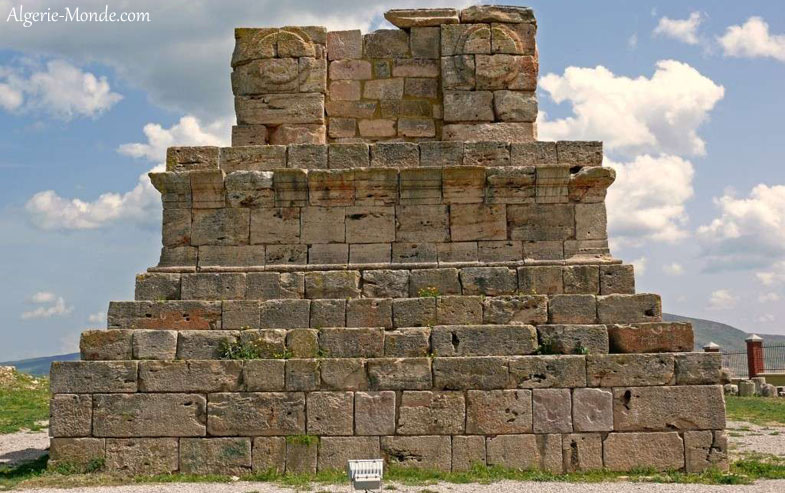
The tomb of Massinissa
The Numidian kingdoms
While Carthage radiated all its power, the Numidian kingdoms of Gaia, Massinissa and Syphax, had reached an exceptional degree of development on the economic, social and cultural levels. Although little, or still poorly known, this period remains one of the most fascinating in the History of Algeria.
For lack of a more precise reference point, we must go back to the history of Carthage to access the chronology of the Numidian Kingdoms. According to Christian chronology, and the stories of Virgil in the Aeneid, Elissa Dido, sister of Pygmalion, king of Tyre, fleeing the oppression of her brother, landed with her treasures and a handful of faithful Tyrians and Cypriots on the African coast of Tunis, around 860-870 BC.
Between the lake and the brackish marshes, in the peninsula formed by the ancient mouth and the alluvial deposits of the Madjerda River, she founded Carthage “Qart Hadast” (new city). It is also in the Aeneid that we find traces of the first historical character from the territory occupied by today's Algeria, Hiarbas or Iarbas, king of Getulia, an ancient region of Africa on the edge of the Saharan Atlas.
According to Virgil, Hiarbas, son of Jupiter Amon and a nymph, asked Dido to marry him. Having suffered a refusal, Hiarbas made war on Carthage. Justin, in the Philippic stories, summary of the great universal history, adapted by Trogus Pompey from an older Greek work, presented the episode to us as follows: "Envoys from Hiarbas, chief of the tribe (Maxyés) arrived at Cathage to ask for the hand of Dido in the name of their master. But they did not dare to rush things and looked for a detour. They pretended to be in search of a prince who would consent to teach Hiarbas and his subjects the means to live in a less barbaric manner."
Herodotus, in the 5th century BC, left us an overview of the living environment and habits of the Numidians: "East of the Triton River, live the Maxyes, a people of sedentary laborers with houses. According to tradition, half of their heads are shaved, the other half sports long hair; henna. They claim to be descended from the Trojans. The region where they live, mountainous, more wooded than the territory of the Nomads, flat and sandy, like the rest of Libya towards the West, abounds in wild animals and large animals: lions, elephants, bears, horned donkeys, bracochons, cinochephales, snakes. the region.
It is difficult to determine with precision the origin of the Numidians, but the hypothesis of the Trojan origin put forward by Maxyès's words is acceptable. Sallust also asserts that the Massyles and Massaéysyles were brought by Hercules during his journey to Spain.
Strabo confirms Sallust regarding the authenticity of Hercules, this fabulous Assyrian king, who would have come from Asia before Cyrus. Despite the profound ignorance we have regarding Numidia until the 4th century BC, everything suggests that its development followed the same route as that of the Mediterranean peoples.
On the political level, Numidia knew independent tribes, village republics, vast kingdoms endowed with strong power which superimposed itself on tribal structures. When Numidia reappeared in the 4th century BC, it formed in the west, the kingdom of Massaeysiles limited by Ampsaga (Rhumel) to the east and by Moulouya to the west, with Siga for capital and the kingdom of Massyles in the eastern part of Constantinois, with Cirta for capital.
Herodotus reports that commercial relations developed very early between Phoenicians and Numidians, thus favoring the penetration of the Punic language and culture quite deeply into the country. The Numidians learned from the Phoenicians the agricultural and industrial processes of manufacturing olive oil and wine, the exploitation and working of copper.
The cultural influence, on the other hand, was very limited and was exerted mainly through Carthage; it only manifested itself with certainty in the domain of art, of which we find examples in the great medracens of Aurès and Tipaza.
According to Polybius, Greek historian, born in 200 BC and connoisseur of Africa having stayed there for a long time, the first king of the Massyles was Navarase, brother-in-law of Hannibal (247-183 BC), great Carthaginian general and statesman. After the First Punic War (264-241 BC) Carthage had to face mercenary warfare, and was helped by the Numidian cavalry of Prince Navarase.
During the years following this war, Carthaginian power weakened, which allowed the king of the Massyles, Gaia, grandfather of Massinissa, to undertake the conquest of the coastal cities, including Hippo-Regius, which became its capital. He was received triumphantly by the population who expelled the Carthaginians.
During the second Punic war (218-202) BC) Romans and Carthaginians fiercely competed for the alliance of the Numidian kingdoms. Allied with Hannibal, the Numidian cavalry distinguished itself brilliantly. She managed to invade Iberia, Gaul, crossing the Pyrenees, then the Alps, helping to win the Battle of Cannae in 216 BC, the most famous victory of Hanninal's troops, which remains, to this day, in the military annals, as an example of strategy and tactics.
The resistance and robustness of the Numidian mounts and horsemen played a considerable role. The Second Punic War will end with the Battle of Zama. It was the Numidian troops of Massinissa, rallied to Scipio, who contributed to the defeat of Carthage, forced to recognize Massinissa as king of Numidia.
In the 3rd century BC, Masseylian Numidia was governed by Syphax who sought to Hellenize his country, as the other peoples of the Mediterranean were doing at that time. The war in Iberia completed and in view of the war in Africa, Carthaginians and Romans sought the alliance of the Numidian king. Scipio then decided to cross the Strait of Gibraltar to negotiate with him.
According to Livy, as Scipio entered the port, Hasdrubal also arrived there. Thus, these two enemies found themselves in the territory of the Numidian prince, flattered to see the two greatest powers in the world come to solicit his friendship at the same time.
Gaia
While Massinissa was in Iberia, Numidia was governed by his father Gaia. At the death of the latter, Carthaginians and Romans were forced to move their centers of interest towards Africa.
Massinissa
The succession to the throne of Gaia took place in the civil war, during which the heir to the throne, the uncle of Massinissa was assassinated by the adventurer Macetulo, who raised the people and placed the young Lacumaces on the throne, while retaining the power.
Massinissa then had to return and face first Lacumaces, then the troops of Macetulo reinforced by Syphax. He defeated Macetulo and regained his father's kingdom, while the fight with Syphax was only just beginning. The latter, pushed by Hasdrubal, attacked and pursued Massinissa fiercely, forcing him to retreat into mountainous areas without stopping the fighting.
As war in Africa became imminent, the two monarchs were forced to take a stand. Hasdrubal forced Syphax, by marrying him to his daughter Sophonisba, to side with him. Massinissa, for her part, in order to be able to recover her father's kingdom reduced by Syphax, found herself alongside Scipio. Thanks to the support of the Romans, in 203 BC, he defeated and took prisoner Syphax whose wife he married: Sophonisba.
Scipio, fearing that Sophonisba would push her husband towards the Carthaginian party, demanded that she be delivered to him. But Massinissa had promised Sophonisba not to hand her over to the Romans and to provide her with poison if this eventuality was confirmed.
And it was so. It was at the end of the Second Punic War that Massinissa was restored to the kingdom of his fathers. The title of king of Numidia with which he was solemnly invested by the Senate, put him in a position to recover territories long held by Carthaginians, and to appropriate cities of Emporia.
The opulent Leptis Magna was among the Carthaginian possessions recovered by the Numidian king. Seventy localities of Zeugitania forming part of the territory of Hippo-Regius and extending as far as the Tasca, were recovered, as well as the region which extends on the right bank of the Madjerda.
At the time of his coronation, Massinissa was 36 years old. Born in 238 BC, he reigned for 54 years until his death in 148 BC. During his long reign, he undertook the construction of a unified and monarchical state. First he focused on settling populations and transforming nomadic pastoralists into farmers.
He favored the urbanization of Numidia, pushing farmers to form large towns, to which he gave an organization similar to that of Punic cities. Massinisssa, who looked with interest at the Greek East, had accepted the form of civilization that six centuries, placed under the influence of Carthage, itself Hellenized during the last two centuries, had brought to the Numidian elites.
He wanted to educate his people according to Hellenistic methods. The political project dearest to Massinissa was "THE UNIFICATION OF ALL THE NUMID KINGDOMS" (North Africa), thus becoming the undisputed Aguellid of his immense kingdom. The recovery of land that belonged to his ancestors allowed him to introduce new methods in fields as varied as agriculture, hydraulics and terrace cultivation.
Massinissa was probably the first to introduce the Hellenistic cult of Demeter and Korah to the peasants. To better ensure his power, he wanted to deify the monarchy and establish the cult of the royal divinity. After his death, a temple was erected to him in Dougga.
On the military level, his power was also considerable: he maintained a powerful army and a large fleet. Economically, Numidia occupied, during his reign, a preponderant place in the world economy of the time. His management made his country a very prosperous state which traded with Greece and Rome.
Cirta was the capital. In his work of unification, he encroached on the domain of Carthage, which declared war on him. Massinissa emerged victorious. The growing power of Massinissa in Africa worried Rome, to the point that by declaring war on Carthage in 149 BC (third Punic War), it also targeted Massinissa.
By destroying Carthage in 146 BC and creating the first Roman colony in Africa, Rome put a limit on the territorial extension of Numidia and the strengthening of its economic and political power. The great Aguellid died at that time without being able to measure the consequences of the fall of Carthage and impose primogeniture as a rule of succession, a negligence which led to serious consequences.
At his death, his kingdom was divided between his three sons: Micipsa father of Hiempsal I and Adherbal, Manastebal father of Jugurtha and Gauda, and Gulussa father of Hiempsal II whose descendants will ensure the lineage of the last Numidian kings.
Micipsa
After the death of Manastebal and Gulussa, Micipsa inherited the kingdom and reigned for 30 years (148-118 BC) Micipsa continued the work of his father, beautified the capital and attracted cultivated Greeks to Numidia to propagate, throughout the country, the arts and culture.
The power of unified Numidia worried Rome, which increased the penetration and forced Micipsa to divide the kingdom undivided between his two sons Hiempsal I and Adherbal and his nephew Jugurtha.
The War of Jugurtha
Could Rome have guessed that this division would spark a war after the fall of invincible Carthage? Numidia will rise up violently and Rome will have, in Jugurtha, an enemy as formidable as Hannibal. Indeed, the division of Numidia imposed by Rome marked the beginning of Jugurtha's struggle to preserve the unity of his homeland.
In 116 BC, he captured all of Numidia and had to eliminate Hiempsal. In 112 BC, Cirta; principality of Adherbal, fell after the siege which ended with the massacre of its defenders and Roman merchants. Rome declared war on him.
"The war of Jugurtha" sung by Sallust, lasted seven years. Six Roman armies disappeared in this memorable struggle. Jugurtha, as quick in decision as in action; adored by the Numidians for its beauty; his courage and the resources of his mind kept the Roman forces in check for a long time.
However, he was harassed by Metellus who devastated fields and villages; and energetically attacked the main Numidian cities. Metellus tried in vain to seize Zama, the invicible. But the consul sacked Thala, with its weapons depot and its royal treasure.
Dispossessed of his cities, Jugurtha was persecuted by Getulia and Mauritania, where he received reinforcements from his father-in-law Bocchus, an alliance which was fatal to him. After suffering various military setbacks, Marius fell on Jugurtha who put up fierce resistance to him as if he were still a formidable enemy. Jugurtha resisted but lost Cirta during the siege of the winter of 107-106 BC.
Delivered in 105 by his ally, he was taken to Rome in chains. He contemplated the city which he despised for its readiness to sell itself. He remained a prisoner there until his death.
Even today, in the ruins of the Roman prison, we can read the inscription dated 104 BC which immortalizes the great Numidian king, fiercely opposed, throughout his life, to Roman imperialism.
In fact, Jugurtha was not defeated but victorious, since today, after more than two thousand years, his legendary figure and his fame have crossed the centuries.
Bochus I - Gauda - Hiempsal III
After his defeat, his kingdom was divided: Bocchus received part of western Numidia. Eastern Numidia was divided into two kingdoms: Western Numidia and Eastern Numidia which returned to Gauda (105-88 BC) then to Hiempsal II (88-68 BC) respectively brother and nephew of Jugurtha.
Bogud - Bochus II
On his death, Bocchus placed his son Bogud on the throne of Western Mauritania who took the name of Bogudiana, and bequeathed his new provinces to his son Bocchus II who called it Mauritania of Bocchus. This division took place in 91 BC.
Bocchus III reigned until 33 BC. He declared himself in favor of Pompey. Nevertheless, Caesar left him his states, then he followed Octavian, while his brother Bogud supported Antony and was thus able to reign over all of Numidia.
Juba I
Juba I succeeded Hiempsal his father, until 46 BC. He took Pompey's side and annihilated the army of Soribornus Curio, who landed in Africa in 49 BC J.C. Defeated at Thapsus by Caesar, he killed himself, as did his allies, Scipio and Cato.
His son, the future king Juba II, while still a child, was taken captive to Rome where he was educated. He married Cleopatra Selené, daughter of Cleopatra and Antony. Augustus restored Numidia to him for a time and in 25 BC. B.C. he became king of Mauretania, whose capital was Iol.
This son of the rebel Juba I, defeated by Caesar, was a very cultured king. Without reaching the political stature of his ancestor Massinissa, nor the exceptional courage of Jugurtha, Juba II strove to create a climate favorable to the development of his people.
Learned sovereign, having traveled widely, influenced by Greek philosophers; he wrote several works on dialectics and brought in Greek artists. They created in Cesarea a very powerful artistic movement which spread throughout the kingdom.
A great admirer of Pericles the Olympian, who made his homeland a model Democracy, Juba II wanted to govern Mauretania in his image. The democratic methods of his government earned him the favor of his subjects, and his great qualities the esteem of foreign nations.
According to Pausanias, Athens erected a statue of him in its gymnasium. It was Greece's homage to Juba Lybico, an African king. Juba II knew the history of his country and even that of other peoples very well.
He is cited as a historian in historical treatises, both Greek and Latin. He also wrote works on theater, painting, grammar, natural sciences, unfortunately his work is lost forever. But the work whose loss is most regrettable is his "Description of Libya".
At the start of his reign, he explored the Fortunes Islands (Canary Islands). Pliny attributes to him the discovery of the Purpuraris Islands (Madeira Islands) whose inhabitants admirably dyed fabrics purple. From his travels, he brought back to Cesarea a vast library and copies of the best sculptures of the "century of Pericles", of the school of Myron and Polycleitos, of Phidas and Praxiteles.
Among the copies of the sculptures of Phidias are the Apollo of Cherchell, Demeter and Korea, powerful sculptures of Parthenonian style, the Venus of Cherchell, which, despite its mutilations, still shines of incomparable brilliance. Juba II's interest in culture did not prevent him from building Caesarea, beautifying it and making the capital of his kingdom one of the most beautiful cities of Antiquity.
The lighthouse of the islet dates from his reign, it has been compared, all things considered, to that of Alexandria. This construction attests that Juba II, like his elders, applied the principles of a true economic policy. The lighthouse was one of the elements of the development of the port, intended to develop maritime traffic on the coast, with a view to trade as well as geographical explorations.
The excavations carried out in the ruins of Cherchell have not revealed all their secrets, but it is certain that part of its splendor is due to Juba II. Many of the capitals on the square must belong to this era.
Juba II left to posterity a city which was a center of culture and art. The Greek sculptures discovered in Cherchell are exhibited at the city museum, the Museum of Antiquities in Algiers and the Louvre Museum in Paris.
Ptolemy
Ptolemy son of Juba II was the last Numidian king. He was assassinated by Caligula in the year 42 AD. At that time, the city extended over 2.5 km long and 1.5 km wide, and contained within its walls a large number of artistic and literary works. A numismatic collection of the last Numidian kings (Juba II, Cleopatra Selene and Ptolemy) is exhibited at the Museum of Antiquities of Algiers.
The coins of Juba II reflect his era very well. There we find both the monetary traditions of the ancient Numidian kings, the Egyptian memories of Cleopatra Selene, the Greco-Roman culture of Juba II, and the desire for rejuvenation of his son Ptolemy, whose reign was short-lived.
The Romans after the death of Ptolemy, son of Juba II, annexed Mauretania. They divided it into two imperial provinces: Tingitan Mauretania and Caesarian Mauretania, which corresponded to the Oran and Algiers "Telles" and the western part of Constantine.
Tacfarinas
A contemporary of Ptolemy, Tacfarinas led the revolt of the Numidians against Roman imperialism under the reign of Tiberius. From the year 17 AD, he waged a merciless war against the Roman armies.
This independence struggle lasted eight years. The warrior Mazipa fought alongside him. Despite the semi-defeats of Tacfarinas, the bloody war between the Numidians and Rome only ended in the year 24, in the battle fought by the pre-consul Donabela in Auzia (Aumale), where Tacfarinas found his death on the field of honor as required by Numidian tradition.
Tacitus devotes an important place to Tacfarinas in books II and III of his Annals and despite the contemptuous tone he uses towards the Numidian Chief, the latter's personality comes out enhanced. Tacfarinas stands up to Caesar, to whom he sent Ambassadors. Caesar refused his demands arguing that even those of Spartacus had not been taken into consideration.