


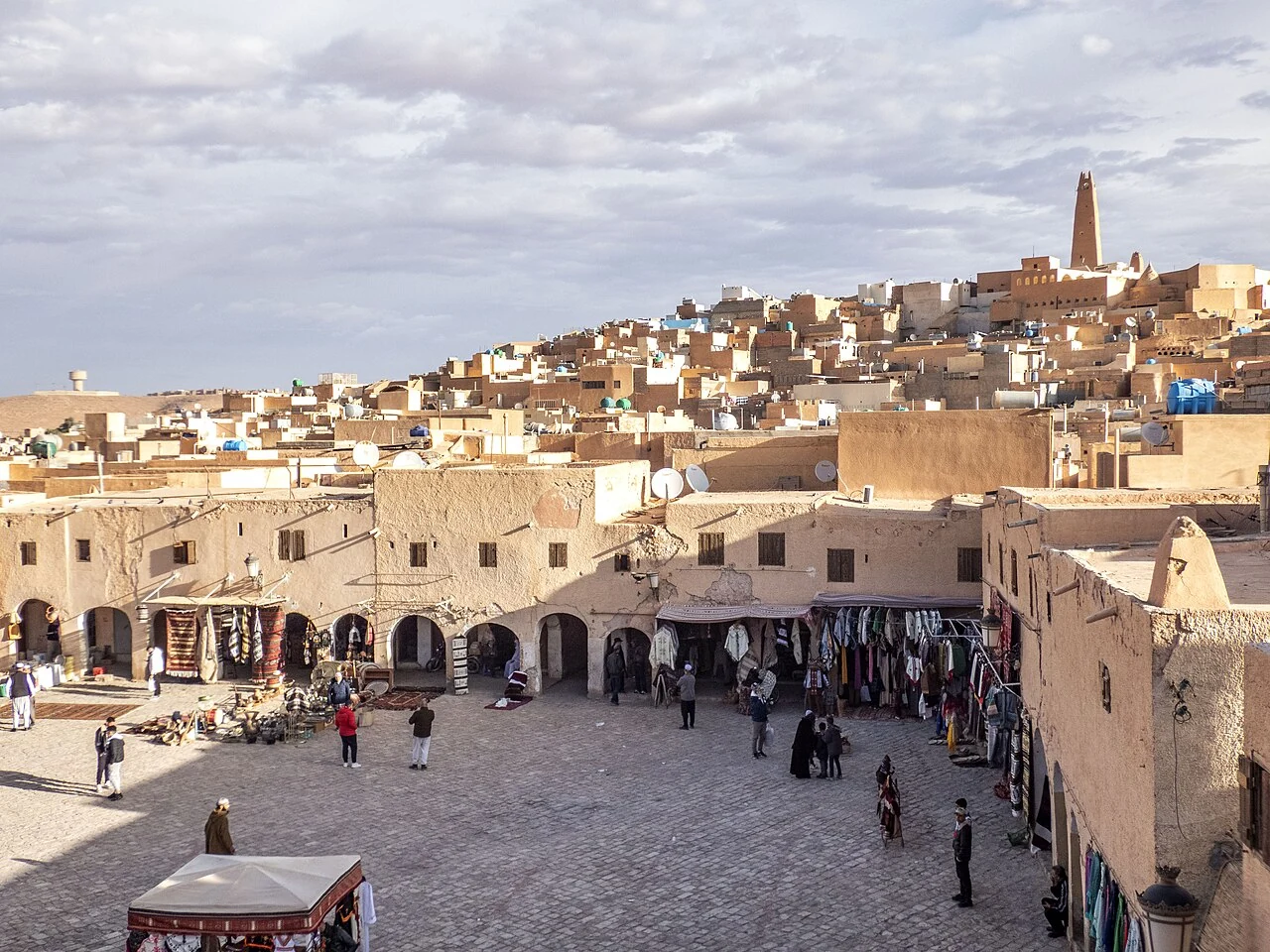
The M’Zab is compelling because its buildings make social ideas visible. Streets, homes, mosques and cultivated places belong to a connected settlement system, not a set of unrelated monuments. Ghardaia provides a familiar starting point, but the wider valley’s heritage cannot be reduced to that town alone. Come prepared to look closely, listen to local explanations and accept that understanding an inhabited place does not require entering all of it.
See a valley of settlements, not one old town
UNESCO describes the M’Zab through five historic ksour and their associated palm groves: El Atteuf, Bounoura, Melika, Ghardaia and Beni Isguen. A ksar is a fortified settlement; the plural is ksour. The names identify distinct places within the heritage ensemble, not five interchangeable neighbourhood stops on a single casual walk.
Before choosing accommodation or excursions, ask the organiser to explain where your base sits in relation to the proposed visits. A good introduction should make the valley’s structure legible and identify the places that can appropriately be visited. Seeing every ksar is less important than understanding how the ensemble works.
Choose comparisons that teach you something
Start by locating all five ksour in your mind, then select a manageable combination with a knowledgeable local guide. You might compare the form of one settlement from an appropriate public viewpoint with a closer walking visit in another. The purpose is to notice relationships between a prominent mosque, the surrounding housing and the edge of the settlement.
Ask why the guide recommends particular stops and whether local visiting arrangements differ between them. An invitation or rule applying in one place should not be carried automatically into another. Avoid a schedule that treats the five names as a checklist; time to discuss one street’s organisation can be more valuable than another hurried arrival.
Read the buildings through their purposes
UNESCO’s account places the mosque at the centre of each historic settlement, with houses arranged around it and defensive structures defining its limits. The minaret also served as a watchtower, while the mosque had a defensive role as a final refuge. The housing expresses a different priority: communal life alongside family privacy. Looking at these purposes makes the ensemble more legible than treating every building as an isolated sculptural form.
On a walking visit, observe changes in scale, enclosure and the relationship between doorways and passing movement. Ask about the local materials and practical construction methods identified by the guide. Avoid reducing every feature to a single climate explanation; the source makes clear that social organisation, defence and family life also shaped the built environment.
Keep the palm groves in the architectural story
The heritage ensemble extends beyond dense settlement. UNESCO identifies the ksar, cemetery and palm grove with its summer settlement as linked elements, and recognises water capture and distribution as central to the relationship with the environment. A visit focused only on streets and facades misses much of what makes the valley distinctive.
Ask whether a permitted garden or water-related visit can complement the urban walk. Let someone familiar with the particular site explain what is still functioning and who maintains it. Do not label every channel a foggara or assume that the M’Zab works like the Souf’s ghout gardens. Different oasis landscapes deserve their own explanations.
Understand Ibadi heritage without freezing people in time
Ibadi community history is fundamental to UNESCO’s description of the valley and its architecture. That heritage remains connected to living people, not a population employed to preserve a visitor’s image of the past. A guide can explain the context while also recognising that individual lives, opinions and occupations are more varied than any short cultural introduction.
Follow current local guidance about dress, routes, photography and religious spaces. Ask before turning into a residential passage or stopping at a doorway, and do not interpret a quiet street as an invitation to explore privately. The architecture’s concern for family privacy is not only an interesting historical principle; it is a reason to be attentive now.
Make a market visit about exchange
If your route includes a market or craft shop, use it to learn about contemporary work as well as objects. Ask what is made locally, where materials come from and whether the seller can identify the maker. The answer may be more interesting than a broad claim of authenticity, and it helps distinguish a local purchase from an item traded through the town.
Discuss a price respectfully and let browsing remain optional. A demonstration, detailed explanation or arranged studio visit may deserve separate payment for someone’s time. Do not photograph traders or customers simply because the setting is public. A useful souvenir is one you understand and can legally take home, not an object with an unverifiable antiquity story.
Alternate the overview and the close view
An editorial itinerary can begin with an orientation to the valley, continue with a carefully chosen ksar walk and then add a complementary palm-grove or craft encounter if locally available. Keeping these experiences separate gives each room to develop. Return to the wider view afterwards: the compact forms often make more sense once the guide has explained the life within them.
Build flexibility around community routines and current visiting arrangements. A closed interior is not necessarily a failed visit; an exterior explanation may be the more appropriate way to understand a religious or domestic building. Ask for alternatives based on the same interest, rather than insist on a replacement that intrudes elsewhere.
Request details about the actual walking route
Architectural visits can involve sustained standing, gradients, steps and uneven surfaces. Ask for a description of the proposed route, the availability of seated breaks and toilets, and the point at which a vehicle can meet you again. Someone who is comfortable with a general town walk may still find a particular historic route unsuitable.
Choose daily timing for the forecast and the group’s needs, not just for a photograph. Confirm local guide arrangements and transport between visits, check official travel advice, and clarify the terms of your insurance. Do not assume that an urban heritage destination removes every practical issue associated with heat, road travel or access.
Photograph form without compromising privacy
The M’Zab invites attention to proportion, repetition and the way buildings sit together. Concentrate on permitted public views and architectural relationships rather than looking over walls or through doors. A rooftop perspective should only be used where it is explicitly offered and where the people responsible can explain what may be photographed.
The best record may include notes as well as images: a local explanation of a building’s purpose, a sketch of a settlement’s form or a question to pursue later. Leave with an account of how architecture supports a community, not just a gallery of shapes detached from the people whose homes gave those shapes meaning.
