


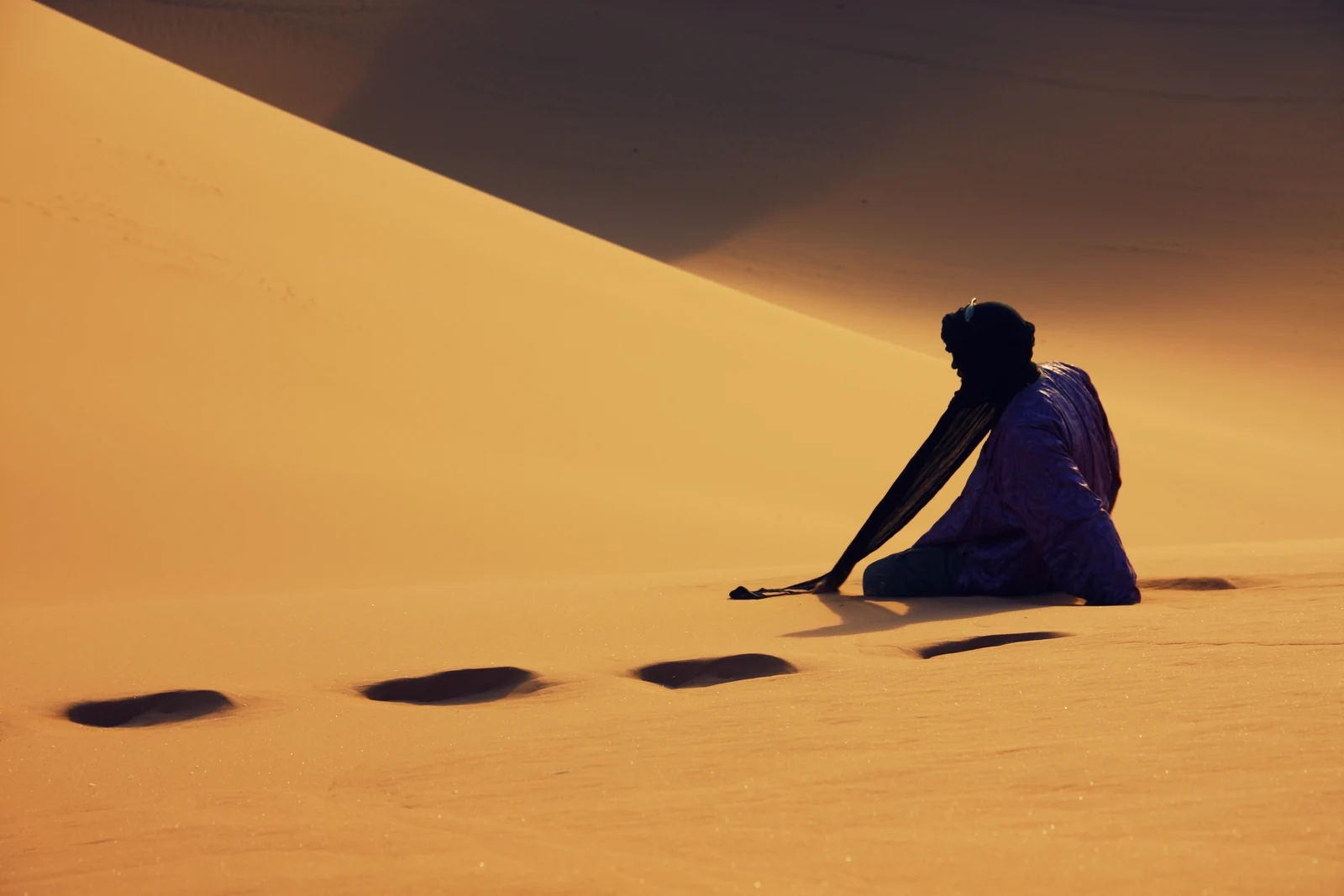
Djanet makes the Sahara feel less like an empty expanse than a landscape to be read. Its wider region contains sandstone formations, paintings and engravings that connect geology with human history. The oasis city is also a place of contemporary life, closely associated with Kel Ajjer Tuareg communities. Give both town and surrounding country your attention: the strongest itinerary does not treat one merely as the departure lounge for the other.
Understand the names before choosing a trip
Tassili n’Ajjer is a vast plateau in southeastern Algeria, recognised by UNESCO for the relationship between its natural formations and archaeological heritage. Djanet is a practical starting point for exploring the region, but a holiday sold under the broad name Tassili may not involve the particular plateau walks or rock-art locations you have in mind. Ask for named stages and an explanation of the terrain.
Tadrart is a distinct destination in the regional tourism offering, not another name for Djanet or a guarantee of visiting the high plateau. Start your planning with three separate questions: where will you go, how will you move through the landscape, and what will you see? A recognisable photograph on a brochure cannot answer all three.
The plateau rewards a walking eye
The sandstone of Tassili n’Ajjer has been shaped by water and wind into an intricate landscape of pillars, recesses and passages. Its interest lies in changing scale: a distant formation can dominate the horizon, while a sheltered surface holds details that only become legible when you stop. UNESCO connects this geology with the region’s long environmental history, rather than presenting it as scenery without a past.
If your priority is walking on the plateau, ask the operator to describe ascents, footing, shade and the longest stretch away from vehicle support. Confirm who carries communal equipment and what you must carry yourself. Choose the route for the experience of being on foot, not simply because the itinerary contains a famous site name.
Choose Tadrart on its own terms
Tadrart Rouge is a mountain landscape in southeastern Algeria with its own rock-art heritage. The Djanet tourism directorate lists Tadrart separately from Sefar and Tassili n’Ajjer, a useful reminder that these labels should not be collapsed into one excursion. If its rock forms and wider desert setting are your main attraction, make that preference explicit when requesting a proposal.
For a vehicle-based Tadrart itinerary, establish how much time is spent travelling and how much is available for walks and unhurried stops. Ask which sites the operator expects to include under the current access arrangements. A trip with vehicle support may still involve difficult ground, and it is not a substitute for checking your own walking and comfort needs.
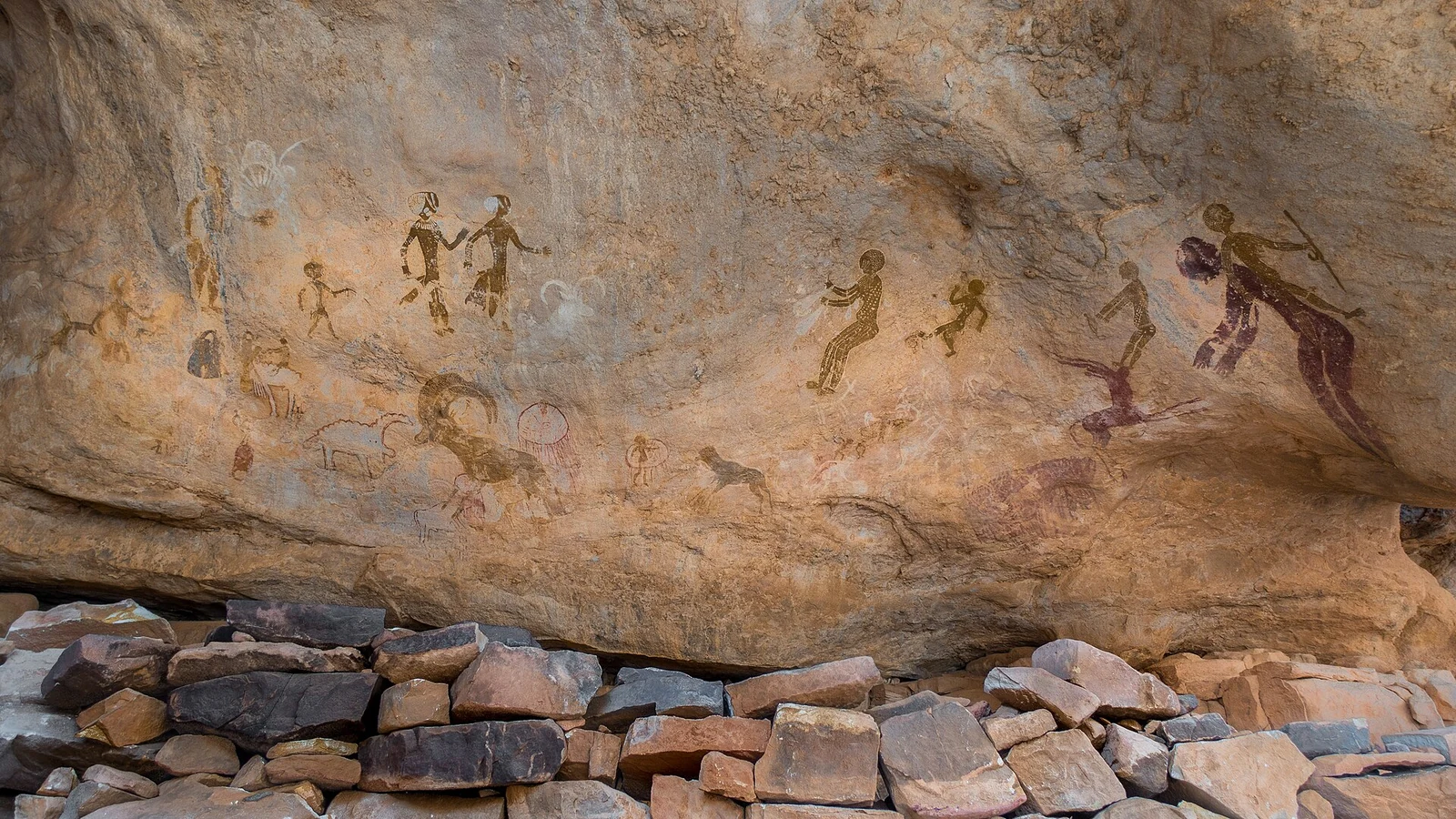
Let the rock art complicate the desert
The paintings and engravings of Tassili record different periods of human life and environmental change. Pastoral scenes and water-dependent animals such as hippopotamuses challenge the idea that this landscape has always looked as it does now. Later images include horses and camels, adding another dimension to the record. A useful guide helps distinguish what is visible from what is interpreted: an animal outline may be clear while the meaning of a gathering remains uncertain.
Spend time with fewer panels rather than racing through a catalogue of motifs. Look first at the whole surface, then at relationships between figures. Never touch, wet, chalk or trace an image to improve its visibility. UNESCO identifies visitor damage as a threat; a faint image is not an invitation to make it more photogenic.
Leave time for Djanet itself
An oasis stop adds human scale to an itinerary dominated by geology. Allow a guided introduction to town, time for ordinary shopping and an opportunity to learn how your hosts describe their own region. Kel Ajjer identity is not a script that every resident must perform, and clothing or a market stall is not permission to turn someone into a portrait.
A meal or an arranged meeting with a maker can be more revealing than another rushed scenic stop. Ask what is produced locally, how an object is used and whether the person selling it made it. Agree on the terms of any demonstration beforehand, and approach hospitality as an exchange between people rather than an included attraction.
Give one main landscape enough time
As an editorial starting point, choose either a substantial plateau-focused journey or a Tadrart-focused circuit before trying to combine them. Add town time at the beginning to discuss equipment and expectations, and keep some flexibility before the onward connection. Combining names on paper is easy; combining their transport, walking and access requirements may not be.
Ask for the proposed order of stops and the reason behind it. Good answers should account for light, walking effort, camp suitability and local conditions, not merely maximise the number of places listed. Request an alternative plan that would still satisfy your main interest if a particular site or route cannot be used.
Make the overnight arrangements part of the choice
A desert camp can give the landscape a different rhythm: the last walk ends, food takes priority and the next day no longer feels like a sequence of transfers. That pleasure depends on practical details. Find out whether you are booking a tent, another form of shelter or an option to sleep outside, and what happens if conditions change.
Clarify sleeping insulation, bedding hygiene, toilets, washing water and dietary needs before leaving town. The team should explain drinking-water provision and waste removal. Ask where batteries can be charged, but plan to use less power rather than assume unlimited supply. Do not wash utensils or yourself at a natural water source without local environmental guidance.
Check the route, not just the season
UNESCO describes visitor groups in Tassili as accompanied by official guides. Treat guided access and current authorisation as matters to confirm with the operator and relevant authorities, not as formalities you can improvise on arrival. Read current official travel advice for the actual itinerary and ask your insurer about its geographical and activity limits.
Prepare for the expected walking, sun exposure and overnight conditions, with clothing that can be adjusted as conditions change. Broken terrain and deep sand demand different effort. Explain health concerns or reduced mobility in concrete terms, and ask how the team would communicate and return you to assistance if the planned route had to end early.
Bring home relationships, not just silhouettes
A satisfying photographic sequence might link a broad rock formation, the texture of its surface and a permitted detail of its cultural setting. Let the guide identify appropriate viewpoints rather than climbing fragile formations for a cleaner frame. Ask about photography restrictions before approaching sensitive places, and obtain clear consent for identifiable portraits or recordings.
Also leave some moments unrecorded. Watching a surface change with the light or listening to a guide explain an uncertain image can make the region more memorable than collecting every standard view. Djanet’s greatest reward is not proving how far you travelled, but returning with a more precise understanding of what you saw.

