


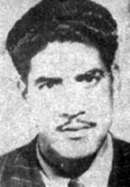
 Ahmed Zahana, better known under the name Zabana, was born in 1926 in the El-Hamri district, in Oran. He completed his primary education there, obtained his school certificate and enrolled in a vocational training center, where he learned the trade of welder.
In 1949, Ahmed Zahana joined the Movement for the Triumph of Democratic Liberties (MTLD.) His dynamism did not take long to attract the attention of the French police who arrested him on March 2, 1950.
He was condemned by colonial justice to three years in prison and three years of travel ban. Upon his release, he resumed his political activities with as much ardor as in the past and participated in the preparations for the outbreak of the war of national liberation.
On the night of November 1, 1954, he organized with a group of patriots the attack against the forest guard post of Oran. On November 11 of the same year, following a deadly clash during which he was also injured, in Gharboudjlid, he was taken prisoner and taken first to the hospital, then to Oran prison.
Summarily tried and sentenced to death, he was the first martyr since the outbreak of the war of national liberation to mount the scaffold, on June 19, 1956, within the confines of Barbarousse prison, on the heights of Algiers.
His execution as well as that of Ferradj had been loudly demanded by the so-called "ultra" colonialist circles, who made it a reason for satisfaction. But the event provoked in Algerian opinion a movement of anger so powerful that it was not long before it resulted in a series of anti-colonialist actions.
It was this climate of effervescence which prepared the way for the battle of Algiers. The sinister guillotine with which Ahmed Zabana and so many other mujahideen were executed is in the central army museum in Algiers.