


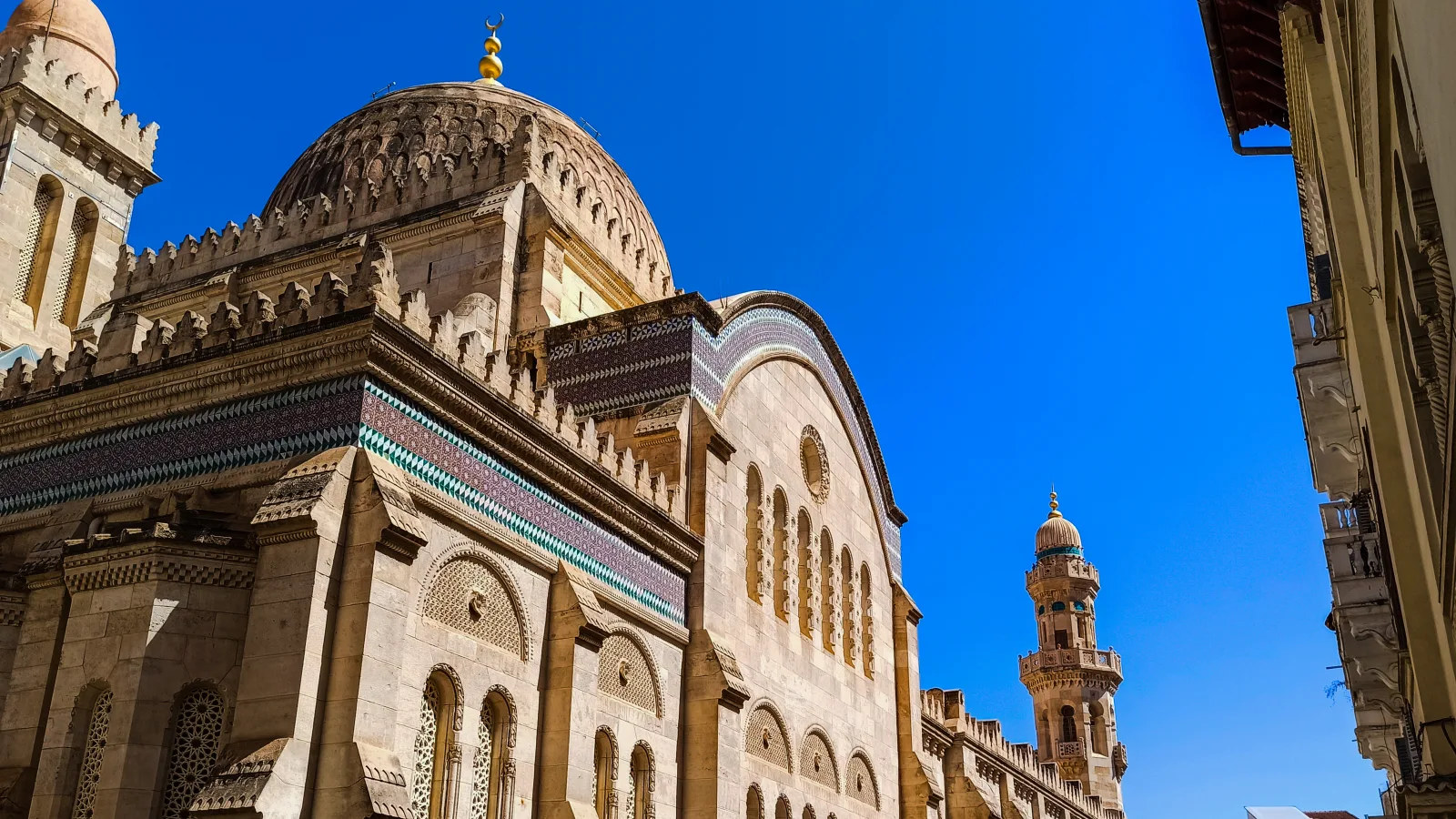
At the foot of the Casbah, Ketchaoua’s broad steps and paired towers make it a natural landmark for an old-town walk. It is also an active mosque. Its exterior is worth seeing in its own right; an interior visit depends on permission and the rhythm of worship, not a tourist’s timetable.
Algiers · Visitor guide
What makes it worth visiting
- A landmark at the foot of the Casbah
- A history spanning mosque, cathedral and mosque again
- An imposing staircase and decorated façade
A building that carries several histories
Ketchaoua’s history includes its Ottoman development, conversion into a cathedral during French colonial rule and return to Muslim worship in 1962. Different sources give conflicting early construction and expansion dates, so a single foundation year can obscure rather than explain its layered past.
A major restoration was followed by reopening for worship in 2018, documented by TİKA, the Turkish cooperation agency involved in the work. Older tourism pages saying restoration is about to begin should not guide a present-day itinerary.
Read the façade from the square
Stand where you can appreciate the staircase, paired towers and ornamental façade without blocking people entering or leaving. The surrounding streets are part of the lower Casbah, so it makes sense to see the mosque in relation to the neighbourhood rather than as an isolated stop.
- Look at the relationship between the steps, entrance and towers.
- Leave room for worshippers and keep the circulation areas clear.
- If access is not permitted, enjoy the exterior and continue your old-town walk without pressing for entry.
Use Place des Martyrs as your reference
The metro operator lists Place des Martyrs station and identifies Ketchaoua among the nearby landmarks. Save the mosque’s name and Place Ben Badis in your map or taxi instructions.
Do not confuse Ketchaoua with Djamaa El Djazair, the much larger Great Mosque in Mohammadia. They are different sites in different parts of Algiers; a generic request for “the big mosque” can take you to the wrong destination.
Ask about entry rather than assuming it
No dependable published tourist timetable, visitor tariff or general policy for non-Muslim interior visits was verified. Ask the staff respectfully whether entry is possible at that time and follow their answer. Prayer, especially the Friday congregation, takes priority.
Allow 20–40 minutes for the exterior and immediate surroundings. Add an interior visit only if authorised. The prominent staircase is an access constraint; anyone needing a step-free entrance should ask about a suitable alternative before making a dedicated journey.
Clothing, photographs and behaviour
Dress modestly and follow instructions about shoes, head covering and photography where applicable. Keep voices low. Photographing architecture does not imply permission to photograph worshippers.
- Ask before entering, even if the doors are open.
- Avoid setting up tripods or organised filming without permission.
- Do not block the steps while a group gathers for photographs.
Continue into the Casbah or towards the sea
A guided Casbah walk adds context to the mosque’s setting. Bastion 23 offers a separate palace-complex visit towards the seafront, but check its opening and Sunday closure first. Keep the route flexible so an unavailable interior does not spoil the whole outing.
Sources & visitor information
Sources checked
Build your itinerary

The Casbah of Algiers: a practical guide to the old town
Explore Algiers’ UNESCO-listed Casbah with advice on local guides, steep lanes, respectful photography, meeting points and nearby monuments.
Read the guide
Bastion 23: visiting the Palais des Raïs in Algiers
Visit the Palais des Raïs, or Bastion 23: palace courtyards, seafront heritage, official opening and ticket information, access advice and map.
Read the guide