


Influenced by the teachings of Mubarek el-Mili and eager to deepen his cultural and political knowledge, he left for Constantine. In 1945 Ben M'hidi joined the Movement of Friends of the Manifesto and Freedom and participated in the congress of March 1945.
During the demonstration of May 8, 1945, Ben M'hidi was arrested and incarcerated in Constantine prison. Upon his release, he resumed his revolutionary activity, sparing no effort to raise awareness of the national cause by notably practicing committed theater. During the 1950s, he left Constantine for Algiers then Oran. At the end of what the enemy called the "1950 plot", the police launched a search for him.
He was sentenced in absentia to ten years in prison, ten years of exile, and to deprivation of his civil rights for ten years. To escape the police, Ben M'hidi had to constantly change his identity, which earned him the nickname the Man with Twenty Faces. In April 1954, Ben M'hidi participated in the constitution of the Revolutionary Committee of Unity and Action (CRUA) of which he became one of the 22 members.
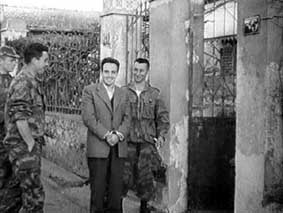 During the congress of this body in Algiers, relating to the political and military organization of the country, Ben M'hidi is appointed head of the Western region. A supporter of work on the ground, he was the typical example of an active politician. In addition to his quality as a theoretician of the revolution, he was omnipresent, organizing people, distributing tasks, setting objectives...
During the years 1955 and 1956, Ben M'hidi left for Morocco and Cairo as an emissary of the Algerian revolution. His activity extended to activist journalism as an active member of the editorial staff of El Moudjahid. His numerous articles and analyzes today constitute valuable documents for understanding the Algerian revolution.
He represented Oranie at the Soummam Congress (August 20, 1956), of which he chaired the first meeting. At the end of the congress, he was elevated to the rank of colonel, appointed to the Coordination and Execution Committee and was entrusted with the Algiers zone. From the beginning, he worked to consolidate the fedayeen groups, to strengthen the political consciousness of local leaders and to organize the bomb network.
Several meetings took place at the Casbah in which Ben M'hidi constantly repeated: “Algeria must become a second Diên Bien Phu. » He also affirmed: “Put the Revolution in the streets and you will see it taken up and carried by twelve million men. » It was in this spirit that he was one of the main initiators of the famous “eight-day general strike” in January 1957.
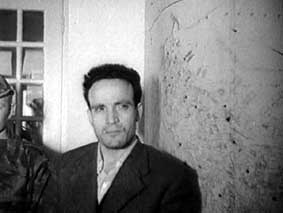 On February 23, 1957, Larbi Ben M'hidi was arrested by Bigeart's men in an apartment on Avenue Claude-Debussy, where he was passing through.
On March 6, 1957, the spokesperson for the general government gave a press conference and indicated that: “Ben M'hidi committed suicide in his cell by hanging himself using shreds of his shirt. »
His suicide was in fact a masquerade to cover up his assassination by Bigeart's men, which allegedly took place on the night of March 3 to 4, 1957.
On August 20 of the same year, the newspaper EI-Maudjahid paid tribute to him in these terms: “The enemy did not take a good look at Ben M'hidi. He would have understood the futility of this torture, the impossibility of shaking this revolutionary for days and nights.
Ben M'hidi was atrociously tortured, all French inventions, all the sadistic techniques of the torturers were applied to him. Ben M'hidi's body, bruised, broken and dislocated, collapsed but we know today that his intact dignity, his unwavering courage and energy filled the enemy with shame."