


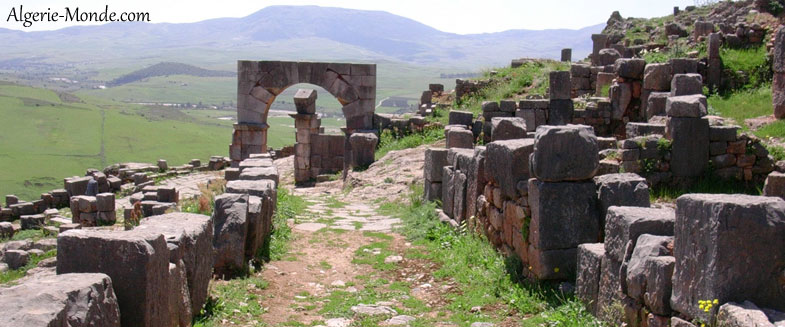
The ruins of Tiddis
Carthage
At the dawn of history, Algeria was populated by the Numidians who retained, from primitive civilization, the Agnatique family and the Aguellid. It is probable that it was this social organization that the Carthaginians found upon their arrival in the 9th century BC.
The Phoenicians founded Carthage around 814 BC, and pushed their ships to Spain. But the African coast of the Mediterranean was very hostile: numerous reefs and shoals made navigation very difficult.
The most daring avoided sailing at night. The need for these stops partly explains the creation of small ports along the coast, every 30 to 40 km, a distance equivalent to a day of navigation. Thus were founded the famous Phoenician trading posts, which played an important role in trade and commerce during Antiquity and beyond.
From east to west, the Algerian coast was home to trading posts which became: Annaba, Skikda, Collo, Jijel, Bejaïa, Dellys, Algiers, Tipaza, Cherchell, Tènes, Bettioua, Ghazaouet... trading posts which would later be the bases of Punic, Numidian and Roman cities.
Carthage extends its influence over the populations of the interior, through commercial relations. Thus cities appeared where the Punic influence is indisputable.
Tiddis
A small Numidian town, 17 km from Cirta-Constantine, Tiddis contains important remains from this period. Archaeological excavations have shown that Tiddis, throughout its history, had a vocation: pottery.
We discovered a vast district of potters there, whose workshops are equipped with kilns, moats and the most beautiful collection of tools from all periods, including the Punic era. The excavations revealed Punic vases and Greek lamps from the 5th century BC.
In the tombs located on the outskirts of the city - the BAZINAS, very advanced burials - vases of an unknown appearance were found.
It is a painted, geometric decoration, with flocks of birds and very stylized dancers. In short, Kabyle pottery, as it is still made today by women, without lathes, using immemorial techniques...
Tiddis also contains ancient remains, DOLMENS, on the western slope of the plateau and, overlooking the Kheneg ravine on both sides, rise around fifty Bazinas at the foot of the mountain to the east.
Cirta
Called SARIM BATIM by the Carthaginians CIRTA, contains, in addition to the remains of Neolithic civilizations such as the Bou-Zabaouine cave, important vestiges of Punic civilization, as well as the stele of EL HORFA, which attests to the maintenance of Punic cults after the fall of Carthage.
We can assume that the populations of the interior spoke the Punic language, because Saint Augustine, a few centuries later, advised his priests to learn Punic, before going to the cities of the interior and the countryside.
The Carthaginian civilization, Hellenized during the last centuries of its existence, spread quite deeply in the country. Its influences are found in later Numidian traditions.
Hippon
Older than Carthage, HIPPONE (Hippo-Regius) retains impressive vestiges of this period; it is assumed that beneath the ruins of its Roman past lies a Punic city.
Isn't the imposing pre-Roman wall proof of this? Hippo-Regius was conquered by Gaia, father of Massinissa, who made it one of the capitals of his kingdom.