

Red heat alert and reinforced Civil Protection readiness
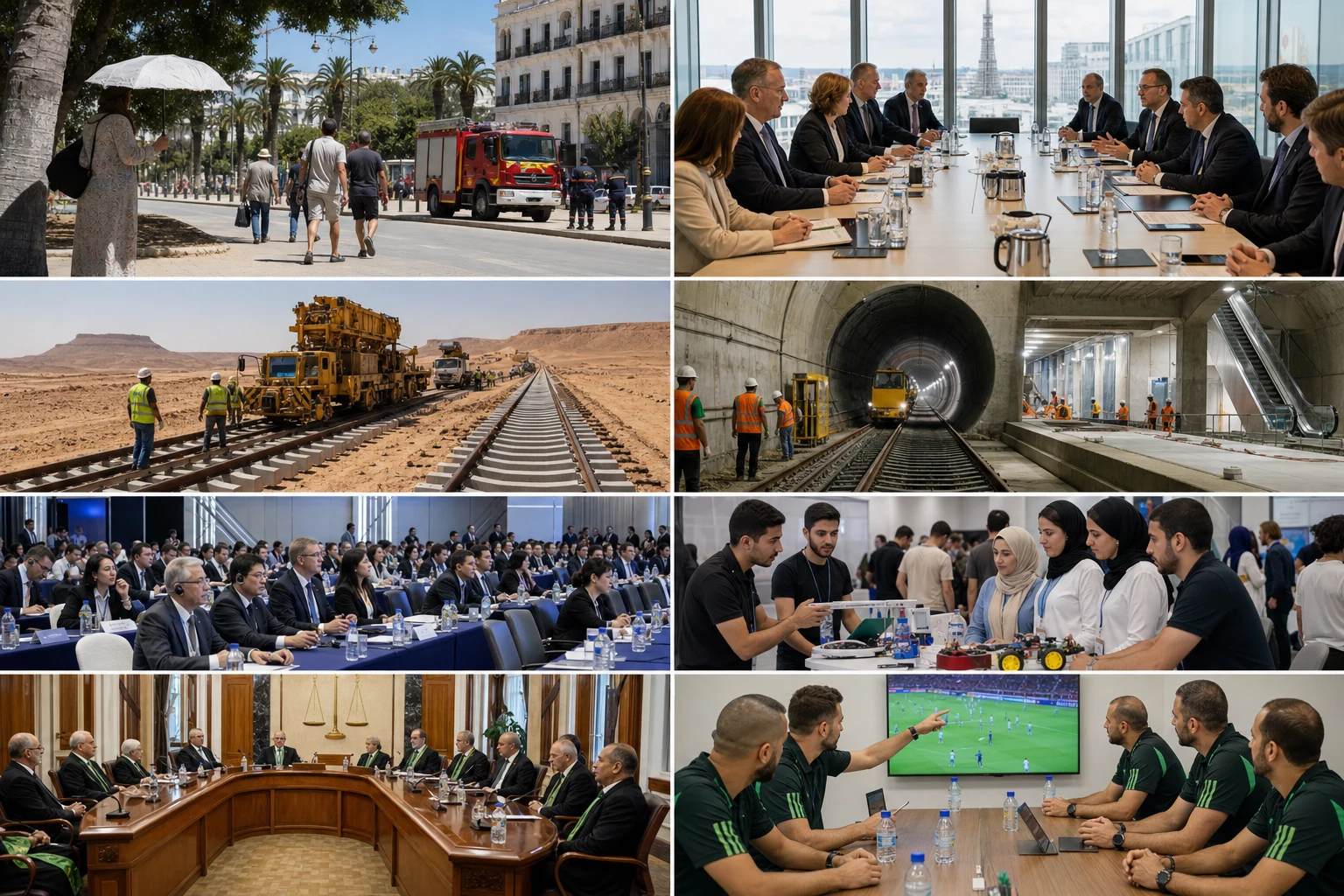
A red-level bulletin from Algeria's national weather office covers Friday 17 and Saturday 18 July. Relizane, Chlef, Ain Defla, Skikda, Annaba, El Tarf and Guelma are the named wilayas. Local highs may reach or exceed 48 C between 09:00 and 18:00. The defined locations and hours matter more than a vague warning about heat across the whole north.
Civil Protection has also called in personnel across a wider group of wilayas as extreme temperatures coincide with multiple fires. Its operational context records 932 fire starts in 32 wilayas between 8 and 15 July. That is a dated seven-day figure, not a live count of fires still burning on Friday and not a measure of casualties or physical damage.
Residents and travellers should expect conditions to differ sharply between regions. Local weather notices and Civil Protection announcements remain the practical reference points during the hottest part of the day. The alert does not support speculation about the origin of individual fires, and it should not be turned into a single nationwide temperature figure.
The two developments fit together: a precise severe-weather warning and a readiness decision by the emergency service. They show how heat can raise operational pressure even before the full impact of an incident is known. The reported threshold remains 48 C or higher locally in the seven wilayas, rather than 50 C everywhere or a blanket alert for all northern Algeria.
Algeria and Germany advance an energy and investment agenda in Berlin
President Abdelmadjid Tebboune's visit to Berlin has put energy at the centre of the Algeria-Germany relationship. The agenda covers gas, the planned SoutH2 hydrogen corridor and possible cooperation on renewable electricity. It also reaches into infrastructure, technology, transport, health, pharmaceuticals, critical minerals, agriculture and industrial projects.
Tebboune said German companies had submitted projects worth about USD 900 million through Algeria's one-stop investment-promotion service. Submitted is the important word. The figure is not proof that USD 900 million has already been invested, approved or disbursed. Discussion of Algerian gas likewise does not amount to a newly signed purchase contract.
A bilateral economic forum is scheduled for 17 July, and the two sides agreed to establish a joint business council. Those mechanisms could bring officials, investors and companies into more regular contact. Their creation is a practical follow-up to the political visit, but it does not settle which projects will proceed or how quickly commercial decisions will be made.
For Algeria, the talks combine an established gas relationship with an effort to broaden investment beyond hydrocarbons. For German businesses, the investment service and business council offer clearer entry points. SoutH2 remains a long-term corridor project. It is not described as operational, and the wider renewable-electricity plans are still cooperation proposals rather than completed infrastructure.
AfDB approves USD 878.09 million for the southern railway corridor
The African Development Bank has approved USD 878.09 million for the second phase of the Laghouat-Ghardaia-El Meniaa railway programme. The operation mainly concerns the 230 km line between Ghardaia and El Meniaa within a wider 495 km programme. Integrated facilities and institutional support are also included in the approved operation.
Implementation is assigned to the Ministry of Public Works and Basic Infrastructure through Anesrif. The stated aims are to reduce transport costs and journey times, connect agricultural and mining production more effectively, encourage local economic activity and improve links along the trans-Saharan railway axis.
Board approval is a concrete financing step, but it is not the same as money already disbursed or construction already completed. The whole 495 km programme should not be confused with the 230 km segment at the heart of this phase. Any construction milestone or commercial opening date needs separate confirmation as the programme moves forward.
The corridor could change logistics for communities and producers along its route, particularly where road distances are long. Its eventual effect will depend on execution, connecting infrastructure and train operations. This digest therefore keeps the focus on what was decided now: the amount approved, the phase covered and the transport purpose of the project.
Algiers Metro extension gets a progress and safety review
Public Works and Basic Infrastructure Minister Abdelkader Djellaoui inspected the Taleb Abderrahmane station site on the extension from Place des Martyrs towards Bab El Oued. The project sits in a dense urban environment and is intended to extend the capital's metro network into one of Algiers' best-known districts.
During the visit, the minister called for faster progress while maintaining deadlines, construction quality and site safety. The work examined included excavation, tunnel reinforcement, ventilation structures and station access. Those details show that the inspection concerned active engineering work rather than a ceremonial announcement.
Cosider Travaux Publics is carrying out the project. EMA is the delegated project owner, Saeti handles monitoring and CTTP provides technical-control support. The allocation of roles is clear, but the available information gives no revised opening date and no new completion percentage.
Passengers can see the extension as part of a longer effort to improve access towards Bab El Oued. For now, the news is about supervision of the works and pressure to keep safety and quality intact while accelerating. It would be premature to announce service changes, an opening or a guaranteed schedule without a separate operational notice.
Algeria signs the founding agreement for an international AI organisation
High Commissioner for Digitalisation Meriem Benmouloud signed an agreement in Shanghai on Algeria's behalf to create an international organisation focused on artificial intelligence and global governance. Algeria is presented as a founding member. The step places the country inside a multilateral discussion about development, safety, research and rules for cross-border AI cooperation.
Benmouloud is also attending the 2026 World Artificial Intelligence Conference in Shanghai from 17 to 20 July. The programme brings together governments, universities, research institutes, companies and international organisations. Topics include technical progress, safety, governance and collaboration between institutions working on AI.
The established development is the signature and Algeria's participation. The organisation's exact powers, voting arrangements and obligations require the founding instrument and later decisions. It should not be labelled a United Nations agency, and there is no basis for saying it already regulates artificial intelligence worldwide.
The conference can give Algerian digital institutions access to research and policy networks, but international membership does not replace domestic work on skills, data, computing infrastructure and public safeguards. Shanghai is best understood as a diplomatic and institutional step in a field where governance structures are still being built.
University of Algiers 3 launches an investment company and ProtoMarket platforms
Higher Education and Scientific Research Minister Kamel Baddari inaugurated an investment company at the University of Algiers 3 and opened the second national ProtoMarket challenge. The initiative is intended to help students move research ideas and project concepts towards prototypes, products and startups instead of leaving them inside classrooms or laboratories.
Two digital platforms were launched alongside the initiative. One is for students seeking support through the investment company, while the other handles ProtoMarket registrations. Cosob president Youcef Bouzenada took part, linking the event to the larger question of how university projects find structured financing and market access.
The announcement does not state a fund size, eligibility rules, an application deadline or any completed awards. Students should therefore wait for the university and platform operators to publish practical terms. The launch creates a route for support; it does not promise financing to every applicant or establish nationwide access without conditions.
The useful test will be whether good prototypes receive technical guidance, business support and follow-through after the event. Universities already generate many ideas, but the path from research to a product can be difficult. ProtoMarket and the new company are designed to narrow that gap, with details of selection and investment still to come.
Constitutional Court sets Saturday 13:00 for final election results
Algeria's Constitutional Court will announce the final results of the 2026 election for members of the People's National Assembly on Saturday 18 July at 13:00. Its notice cites Article 191 of the Constitution and Article 211 of the amended organic electoral law.
This is a scheduling notice, not an early publication of the outcome. It contains no final seat totals, party ranking, revised turnout or ruling on an individual appeal. Provisional figures should not be presented as final before the Court makes its announcement.
The precise time gives citizens, political parties and the media a clear institutional point to follow after the electoral process. Until then, projections remain separate from the final legal announcement. The Court's decision, when published, can be reported on its own terms.
This item is deliberately concise because there are no results to interpret yet. The verified public information is limited but useful: the institution, the date and the hour. Adding forecasts would turn a straightforward calendar notice into speculation.
Football: FAF technical college reviews Algeria's World Cup campaign
The Algerian Football Federation's technical college met on Thursday 16 July to assess the senior national team after its elimination from the 2026 World Cup. The college is a consultative body whose members can examine sporting performance, preparation and technical choices before giving advice to the federation.
The meeting starts a formal review of the tournament campaign, but it does not decide the future of head coach Vladimir Petkovic by itself. There is no established announcement that he has been dismissed, retained under a new deal or replaced. Those are separate decisions that require a clear statement from the FAF.
Coaching rumours often multiply after a disappointing tournament. The useful distinction is between the fact of a technical meeting and claims about its outcome. Comments from pundits, former players or unnamed people should not be treated as a federation decision.
Supporters will want to know how Algeria responds before its next competitive fixtures. The answer will depend on what the FAF chooses after the review and its discussions with the coaching staff. For now, the technical college provides analysis, not a final verdict on the national-team bench.