

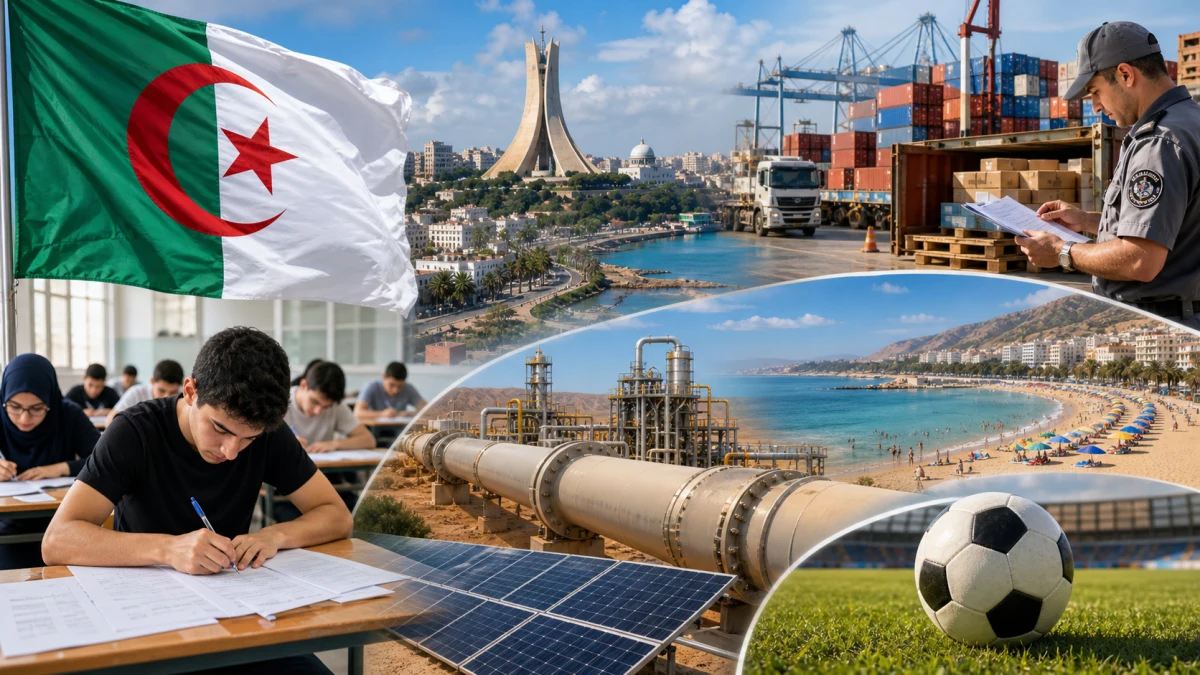
The June 8, 2026 Algeria daily news digest brings together nine confirmed items across product controls, beaches, Eid follow-up, exams, OPEC+, the Trans-Saharan Road, African business, water and football.
Control laboratories are ordered for ports and airports
The strongest practical item concerns consumer-product safety. Authorities are to set up control laboratories at ports and airports, with the ministries and services responsible for commerce, market regulation, health and technical checks involved. The digest treats this as a prevention measure: goods intended for consumption should face stronger checks before they enter regular distribution channels.
The instruction does not mean that every laboratory is already built, staffed or producing test results. It points to a border-control and market-safety plan that still needs operational detail. The file touches food, meat, cereals, traceability and specialist roadside checks. The next public facts should be installation timetables, staffing, methods and official inspection reports.
The practical chain is broader than a laboratory room: sampling rules, customs coordination, health alerts and market follow-up must work together. That is why the public text keeps the difference between an instruction and a fully operating inspection system.
Free beach access is put back on the summer agenda
The second public-service item concerns beaches. Instructions call for free access to be guaranteed, summer follow-up to be strengthened and illegal occupation of public beach areas to be tackled. Motorised water-leisure zones are also to be better marked, so that family areas, commercial activity and sports use are separated more clearly and accident risks are reduced.
The wording remains careful: the digest reports measures to be taken, not a problem already solved. The subject matters to families, visitors and Algerians returning from abroad for the summer. It also depends on municipalities, security services, civil protection and tourism staff on the ground, so later evidence will be needed to judge enforcement.
Summer beach enforcement also has an economic side because nearby parking, kiosks, rental activity and access roads can shape the visitor experience. The digest keeps that context factual and avoids saying every local site will apply the same pace.
Eid sheep distribution problems move into a correction phase
The Council of Ministers also addressed shortcomings in the Eid sheep acquisition and distribution operation. The Agriculture, Rural Development and Fishing minister was instructed to remedy the problems, particularly around organisation and distribution. The public fact is that the administration acknowledges weaknesses in an operation that directly affected household preparations for Eid.
The digest does not turn those weaknesses into criminal accusations and does not name responsible parties. It keeps the focus on corrective work and better organisation. For readers, the practical questions are availability, queues, territorial distribution, information for citizens and control of the supply chain. More precise figures need to remain tied to official follow-up.
For households, the Eid sheep file is not abstract administration. It concerns purchasing points, transport, information and fair access. The article therefore records the corrective order without adding claims about motives, sanctions or hidden responsibility.
Baccalaureate 2026 continues with digitised preparation
The 2026 baccalaureate began on June 7, with more than 876,000 candidates nationwide. The Education Ministry has highlighted preparation carried out in a zero-paper mode, reflecting a more digitised organisation of the examination. Confirmed details concern mobilisation of centres, supervision, procedure security and management of a test that closes the secondary-school cycle.
This digest does not repeat Internet speculation or publish exam subjects. It treats the item as a public-service file involving rooms, invigilation, transport, meals, energy support and communication with families. Digital preparation does not replace local education teams; it adds management, traceability and administrative coordination around a very large examination.
The scale of the baccalaureate explains why it appears in the digest even without new exam results. A national exam of this size mobilises schools, local authorities and service providers for several days.
OPEC+ sets a July production increase
On energy, Algeria and six OPEC+ partners have agreed a collective production increase of 188,000 barrels per day from July 2026. Algeria's reported share is 6,000 barrels per day. The item belongs to international oil coordination and is written as a quota decision, not as output already delivered.
The digest avoids price, revenue or market forecasts. It records Algeria's coordination with Saudi Arabia, Iraq, Kazakhstan, Kuwait, Oman and Russia, while leaving concrete effects for July implementation and later meetings. Actual impact will depend on compliance, demand, market conditions and future decisions inside the OPEC+ framework.
The July oil decision is also presented separately from the country's gas and infrastructure files. It is a short-term production-coordination item, not a promise about export earnings or investment budgets.
The Trans-Saharan Road committee meets in Algiers
Algiers hosts the 77th session of the Trans-Saharan Road Liaison Committee on June 8 and 9. The meeting is expected to examine the gradual transformation of the Algiers-Lagos route into an economic corridor, with partner countries, financial institutions and public-works and transport officials involved. The file links infrastructure, trade and African integration.
The road is described as highly advanced, but the digest does not say the whole corridor is complete or already operating at full economic capacity. The useful public fact is the review of progress by country, transit issues, trade links and investment needs. Operational decisions should be assessed after the committee work is reported.
The road meeting also brings Algeria into a corridor discussion that includes neighbours and Sahel partners. The digest stays with the scheduled institutional work and avoids declaring a commercial corridor before the governance pieces are complete.
African Business Fair continues in Algiers
The fourth African Business Fair continues in Algiers through June 8. The event brings together African delegations, companies, business organisations, exhibition areas, panels and B2B meetings. For Algeria, it is a platform for contacts around trade, investment, exports and access to continental markets.
No contract, order or investment value is added without separate confirmation. The confirmed daily fact is the exchange platform and broad continental participation, not a measured commercial result. In the digest, this item sits beside the Trans-Saharan Road file because infrastructure and business contacts are two parts of Algeria's Africa-facing economic agenda.
Business fairs often produce contacts before they produce public contracts. The wording therefore stresses participation, meetings and continental positioning, which are the confirmed facts available for a daily news resume.
Relizane and Mascara appear in water-supply follow-up
The regional section keeps water-resource projects in western Algeria, especially Relizane and Mascara. Available reporting refers to ministerial visits, distribution, allocations and projects intended to improve supply. The wording is deliberately measured because precise figures and delivery calendars need sector-authority confirmation before they become headline claims.
Water remains a sensitive public service before summer. The digest does not say shortages are solved or that every project has been delivered. It identifies local files to monitor: connections, mobilised volumes, distribution between municipalities, handover dates and the concrete effect on households.
The water item is kept despite the verification caution because western local supply projects affect daily life. It remains regional and cautious, with exact delivery promises left for later public-service confirmations.
The national football team stays in the sport spotlight
The sport item concerns the national football team. The President received the squad at the Presidency before the 2026 World Cup, in a period when preparation is closely watched. Several sport reports also say Vladimir Petkovic's contract has been extended until July 31, 2028, a move presented as technical continuity.
The digest does not predict World Cup results and does not turn the official reception into tactical analysis. It keeps two public facts: an institutional message to the national group and a stability decision around the coach. The next sport markers will be matches, squad choices, player fitness and final preparation.
The sport section combines official reception and contract continuity because both affect the national-team environment. It does not make Petkovic's extension a guarantee of form, selection choices or tournament progress.