


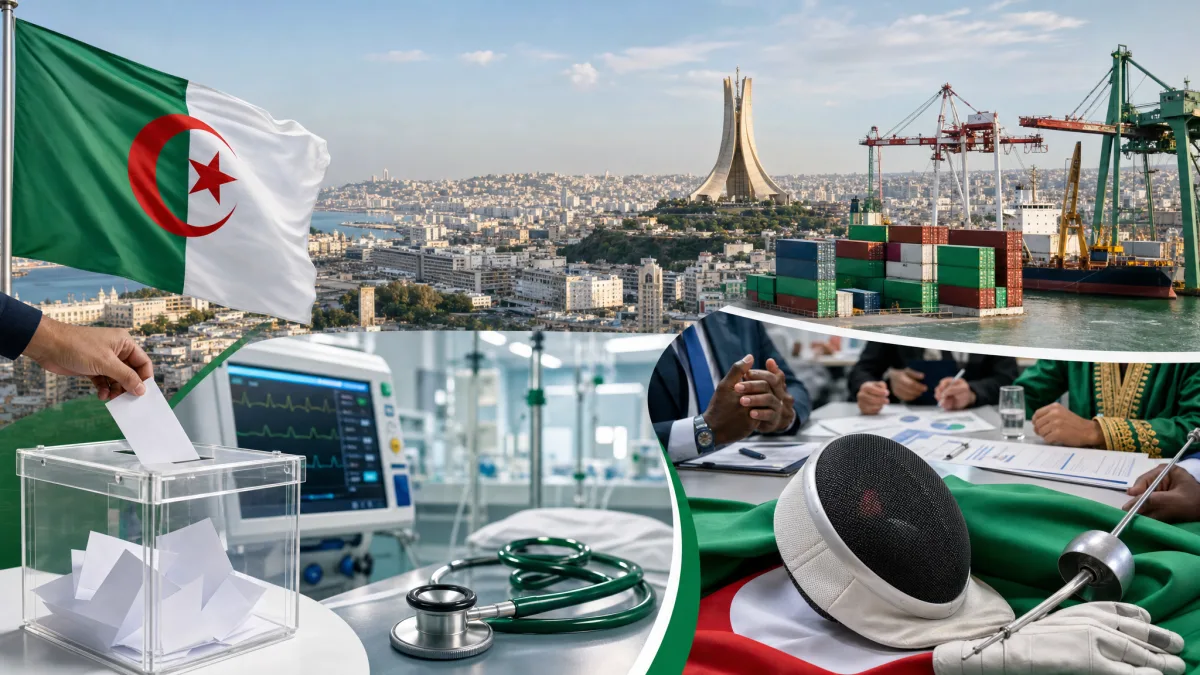
The June 6, 2026 Algeria daily news digest brings together ten confirmed items across African business, institutions, health, training, transport, administration, industry, climate and sport.
African Business Fair opens an economic sequence in Algiers
The fourth African Business Fair is being held in Algiers from June 6 to 8, with participation announced from more than twenty-five African countries. The event brings together companies, investors, chambers of commerce, professional organisations and institutional representatives around intra-African trade, innovation and business partnerships.
For Algeria, the venue matters because it places Algiers inside the practical conversation around the African Continental Free Trade Area. The digest records the opening, dates, announced participation and economic themes. It does not claim signed contracts, achieved trade volumes or continental decisions that have not been confirmed.
The accepted file also keeps the business fair as an event item, not a claims item. The useful facts for readers are the dates, the continental scale and the types of participants expected in Algiers.
ANIE says it is prepared for the July 2 legislative election
Karim Khelfane, interim president of ANIE, said the election authority is ready to supervise the legislative election scheduled for July 2. His line stresses neutrality, transparency, respect for the legal framework and continuity in the administrative stages before the campaign period.
The item remains institutional. It does not validate individual lists, decide appeals or predict turnout and results. What it shows is that the body responsible for the vote is presenting its arrangements as ready while candidacy files, ballots and the campaign calendar move into a more visible phase.
This distinction is important because election administration and election competition are separate matters. The digest reports the administrative readiness statement without turning it into endorsement of any political side.
Health equipment gets a national reference framework
The Ministry of Health launched the national health equipment reference framework, presented as a standard-setting tool for essential medical devices by care level and specialty. The framework distinguishes primary care, secondary care, regional specialised structures and national reference establishments.
The practical effect is on purchasing, public tenders and investment planning across provinces. The digest does not say all hospitals already have the listed equipment, and it does not claim immediate improvement in service quality. It reports a planning instrument designed to make future allocations more consistent and easier to update digitally.
For provincial health managers, a reference list can become a common language between needs, budgets and tenders. The public article therefore stresses planning value rather than promising instant equipment delivery.
Algerian students honoured after the Shenzhen Huawei final
President Abdelmadjid Tebboune congratulated Algerian students who won major distinctions at a Huawei global final in Shenzhen, China. The students come from Algerian universities and schools, and their performance is being framed as a sign of national scientific and technology skills.
The education and technology item is deliberately kept within its confirmed limits. It does not inflate the number of winners without additional verification, and it does not turn a congratulatory message into a new public programme. It records the achievement and the official recognition attached to it.
The Shenzhen result also matters because it links Algerian campuses with global technology competitions. The wording remains careful and does not infer employment, scholarships or future contracts.
Algeria attends the TechSkills vocational forum in Cairo
Algeria is taking part in the first TechSkills Forum for Mediterranean technical and vocational education in Cairo, represented by Vocational Training and Education Minister Nacima Arhab. The forum is organised in an Egyptian-Italian framework and includes public officials, international organisations, companies and specialised bodies.
The themes include digital transformation, automation, artificial intelligence and changing job skills. The digest treats the event as a cooperation and skills-development item. It does not add agreements, funding or domestic reforms that have not been announced in the accepted material.
Vocational training is treated as an economic file, not only an education file. Digitalisation and automation change the skills demanded by employers, which is why the Cairo forum enters the digest.
Algiers and Damascus discuss agriculture, fishing and aquaculture
Agriculture Minister Yacine El-Mahdi Oualid met Syrian Foreign Minister Assaad Hassan Al-Chaibani to discuss cooperation in agriculture, fishing and aquaculture. The discussion covered Saharan agriculture, adaptation to dry conditions, drought-resistant seed production, research and technology development.
The wording stays at the level of sector talks. The digest does not say agreements were signed, trade volumes were fixed or projects were launched. It shows that the two sides are placing food production, water-stressed agriculture and aquatic resources among possible bilateral cooperation channels.
The agriculture item is kept separate from broader diplomacy. It concerns practical sectors: seeds, dryland farming, fisheries, aquaculture and research links that can be discussed without claiming signed agreements.
Algiers port receives instructions on cargo and summer passengers
Said Sayoud inspected the Port of Algiers with instructions concerning cargo processing, shorter waiting times, coordination with police and customs and faster preparation of passenger facilities. Passenger quays 8 and 9 are part of the file linked to summer travel reception.
The item connects economic logistics with services for Algerians travelling through the capital's port. The digest does not guarantee that queues have disappeared and does not publish operational figures not rechecked at the time of writing. It records the administrative priorities: fluidity, coordination and readiness.
The port instructions are also public-service information for families and businesses. Cargo flow and passenger reception meet in the same facility, especially when summer travel increases pressure on terminals.
Official texts set names and transfer rules for the new provinces
Official Journal no. 40 of June 3 includes the texts naming the eleven new provinces, fixing their chief towns and assigning their numbers. The same regulatory package sets rules for sharing assets, liabilities, rights and programmes between the mother provinces and the new entities.
Some patrimonial operations are tied to a December 31, 2026 deadline, while financial operations are linked to the close of fiscal 2026. The digest presents this as administrative and budgetary implementation, not as proof that every territorial service is already fully deployed.
The legal texts matter because administrative creation must be followed by property, debt, budget and programme transfers. The digest therefore names the implementation step rather than only listing the new provinces.
NOVER Chlef restarts pressed-glass activity after furnace renovation
NOVER's Chlef plant, linked to ENAVA and the ACS group, has restarted pressed-glass activity after renewal of its melting furnace. The available information refers to three modernised production lines, an announced capacity of 45 tonnes per day and initial orders for the domestic market.
The industrial angle is local integration and lower import dependence. The digest treats capacity and market-coverage figures as company-reported or business-press information, not as already achieved effects across the national market. It reports a relaunch, not an immediate transformation of supply.
For Chlef, the restart is a local industrial signal. The article notes the plant, the furnace and production lines while avoiding a stronger conclusion about prices, imports or national supply.
Climate risks for children and fencing medals complete the digest
A report supported by the Health Ministry and UNICEF continues to frame climate risks for children in Algeria: heat, drought, floods, fire exposure, desertification, health, nutrition, education and infrastructure. The item is used as a society and environment update, without presenting the report itself as newly published.
In sport, Algeria's senior fencing team added three team medals at the African Championship in Abidjan: two silver and one bronze. Those results follow earlier individual medals and provide the required sport item, while the article avoids declaring a final medal table before the event has fully ended.
The closing pair gives the digest a society-and-sport balance. Climate risks affect children across health and education, while fencing supplies a verified continental result for Algeria.