

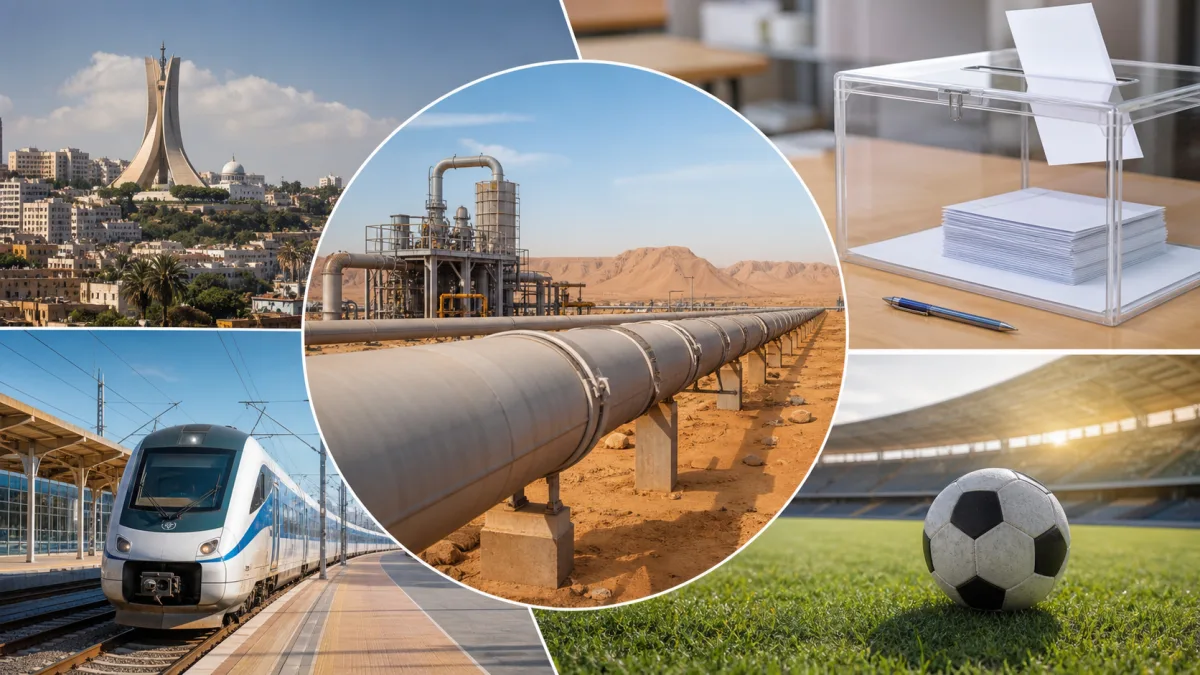
The June 5, 2026 Algeria daily news digest brings together eight confirmed items: energy, elections, infrastructure, diplomacy, seismology and World Cup preparation.
Trans-Saharan Gas Pipeline work starts at Aoulef
Work on the Algerian section of the Trans-Saharan Gas Pipeline was launched on June 4 in the Aoulef area of Adrar province. The ceremony brought together Mohamed Arkab, Nigeria's Ekperikpe Ekpo and Niger's Hamadou Tini, with Sonatrach, NNPC and Sonidep also present around the same regional energy file.
The careful reading is that Algeria's section has moved from the updated feasibility-stage narrative into a works launch. That does not mean the full Nigeria-Niger-Algeria corridor, which is described as more than 4,000 km long, is already built, fully financed or operating. The digest keeps that distinction clear.
The location matters. Aoulef puts Adrar directly inside an African energy story that is often discussed from capitals and conference rooms. A field launch gives the file more substance, but it still leaves open the questions of cost, sequencing and final commissioning.
Adrar's role in the gas corridor
At Aoulef, Arkab described the Algerian section as a central part of the future route for receiving and moving Nigerian gas through Niger into Algeria, while also making use of additional local gas, especially from southern basins. Niger's minister also referred to a Nigerien section of more than 700 km, with a launch expected at the beginning of 2027.
Those details make the pipeline story more concrete, but they do not remove the open questions. The public article does not add revenue estimates, commissioning promises or claims that exports have already begun.
The safest public angle is regional coordination plus staged infrastructure. Algeria is presenting its section as a technical link between upstream gas, local basins and export infrastructure, while Niger and Nigeria remain separate parts of the same chain.
Legislative lists asked to rank candidates
ANIE asked validated candidate lists to submit a document setting the order of candidates on each list. The instruction applies to party-backed lists and independent lists for the July 2, 2026 election of members of the National People's Assembly.
The election authority linked the step to ballot-paper preparation and reminded applicants that the deadline for filing a new candidature is Saturday, June 6, at midnight. The item is procedural: it does not predict results, rank parties or publish final list totals not confirmed in the captured material.
This kind of administrative step is easy to miss, but it affects how voters will see the lists on election material. The digest treats it as ballot preparation rather than campaign commentary.
Eastern mining railway works inspected
Public Works and Basic Infrastructure Minister Abdelkader Djellaoui inspected structures on the Aïn Sennour-Bouchegouf stretch between Souk Ahras and Guelma, part of the eastern mining railway project. The cited stretch is 72 km, and the visit included 17 bridges over an 8 km section as well as works in Souk Ahras, Ouilene, M'daourouch and Oued Kebrit.
The project remains a construction and logistics story, not an opening announcement. The digest reports the inspections, the structures under construction and the call to speed work without saying the railway is already carrying traffic.
For readers in the east, the useful point is the state of the physical works: bridges, tunnels, viaducts and rail-correction sites. Those are concrete signs of progress, but they are still part of a chantier, not public service.
Algeria and Syria discuss cooperation mechanisms
President Abdelmadjid Tebboune received Syria's foreign minister, Assaad Hassan Al-Chaibani. Ahmed Attaf also hosted his Syrian counterpart for bilateral talks covering relations between the two countries and wider regional files.
The discussions referred to relaunching the joint commission, an Algerian-Syrian business council and sectoral working groups in energy, agriculture, mining, transport and training. The wording remains diplomatic; it does not present these mechanisms as already implemented.
Because the Syria file carries wider regional weight, the digest avoids reading more into the meetings than the official language supports. It records the audiences, the cooperation channels named and the sectors listed.
That restraint matters for readers outside Algeria as well. The meeting is notable as a bilateral contact, but the usable facts are the names, the venues and the cooperation formats, not a broad claim about a changed regional order.
CRAAG reports tremors in Batna and Skikda
CRAAG reported a magnitude 4.9 tremor at 00:16 in Batna province, with the epicentre placed 2 km south-east of Aïn Djasser. A second tremor, magnitude 3.5, was recorded at 15:26 in Skikda province, 12 km north-east of Collo, offshore.
The digest treats both as seismological notices. It does not add casualty figures, damage claims or safety instructions absent from the captured statements.
Algeria's World Cup group-stage kits are set
FIFA published the colour choices for the 2026 World Cup group stage. Algeria will open against Argentina on June 17 in Kansas City in green shirts and white shorts, with the goalkeeper in yellow. Against Jordan on June 23 in Santa Clara and Austria on June 28 in Kansas City, the outfield players are listed in white and the goalkeeper in blue.
This is practical tournament information rather than a sporting forecast. The digest keeps the dates, opponents and kit details without adding predictions about Group J.
Commemorative stamp marks the World Cup return
The Algerian Football Federation and the Ministry of Post and Telecommunications co-chaired the June 3 cancellation ceremony for a commemorative stamp honouring the national team's participation in the 2026 World Cup. Algeria's Group J includes Argentina, Jordan and Austria.
The stamp item is institutional and commemorative. It rounds out the sports section without repeating the Netherlands friendly result or adding unsupported promises about the team's campaign.
It also shows how qualification is moving beyond the pitch into public symbols. That is worth noting in a daily digest, provided the article keeps it as a sober institutional item rather than a forecast of what will happen in June.
Taken together, the eight items give a direct news résumé rather than a commentary column: energy works in the south, election administration, transport infrastructure, bilateral diplomacy, two seismic notices and two World Cup-related updates. Each item stays within the confirmed facts and avoids turning procedures, inspections or commemorations into predictions.