


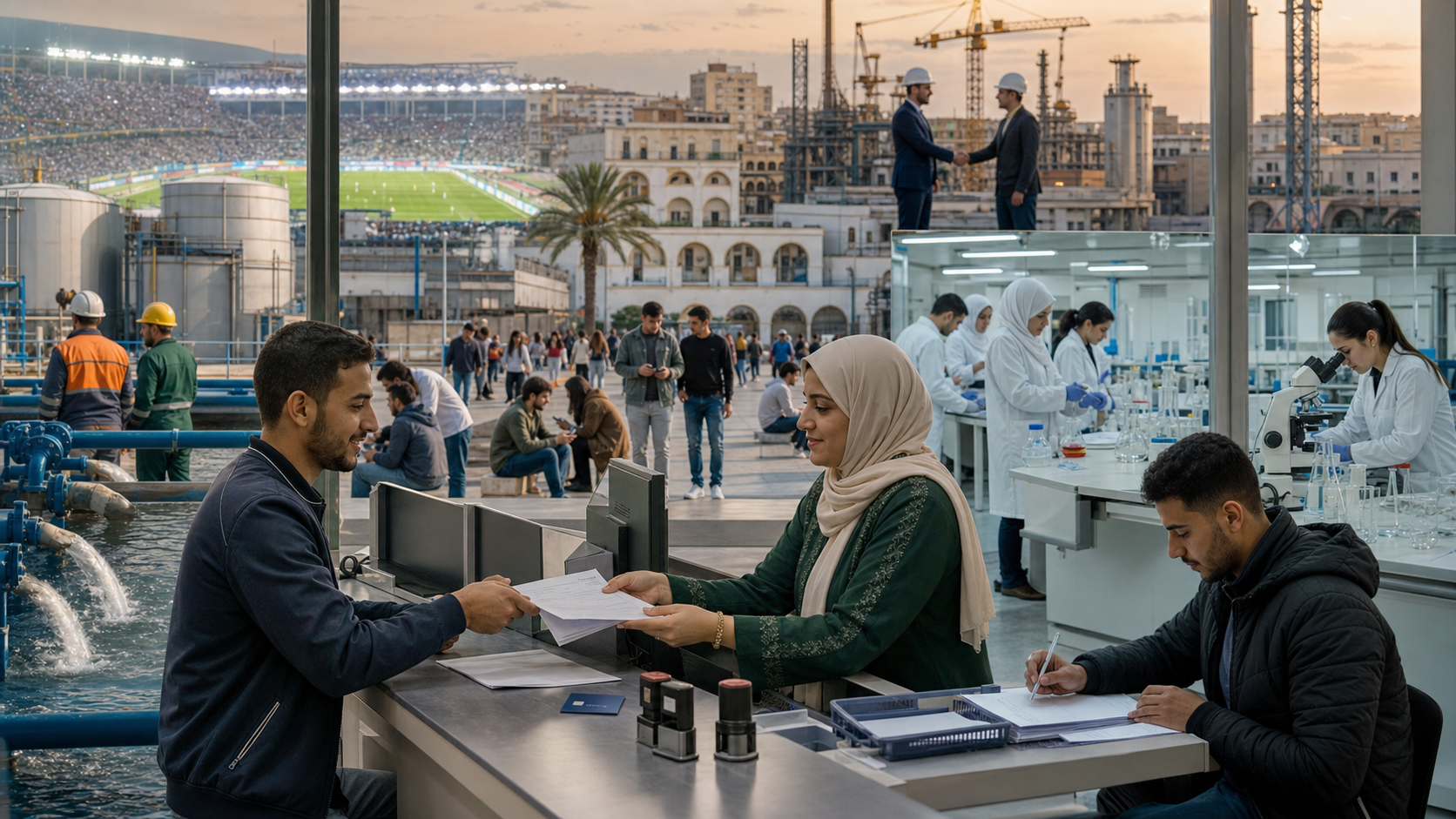
Algeria News Digest, June 30, 2026: Voting Leave, Banking, Water, Health Science, Industry, Insurance, Youth and Football
Workers receive paid leave authorisation to vote on July 2
The digest opens with a practical public-service measure linked to the July 2 legislative elections. Workers are covered by a special absence authorisation without loss of pay so they can vote.
The wording stays within the verified frame. It does not turn the announcement into a complete workplace manual, and it does not invent proof requirements, exact absence hours or private-employer procedures.
For readers, the value is straightforward: the voting day now has a general labour-right marker. Any operational detail still belongs to the relevant employer, administration or official text.
The paragraph also protects the date integrity of the edition. It gives the reader the public measure without explaining collection windows, internal sourcing or newsroom timing.
It also keeps the article neutral around the election itself: the confirmed public fact is voting access for workers, not campaign messaging or an endorsement of any list.
Bank of Algeria narrows the excessive-interest-rate threshold
Financial regulation is the main economy item. Bank of Algeria instruction no. 06-2026, dated June 29, modifies the framework for excessive interest rates and cites a 5% margin above the average effective rate for comparable operations.
The digest does not promise an automatic fall in loan rates. A central-bank instruction defines a supervisory threshold; its market impact depends on banks, contracts and enforcement.
The item matters because it touches the cost of credit for households and businesses. It gives readers a clear regulatory figure without making unsupported claims about immediate banking behaviour.
The 5% figure is useful because it is specific, but it is still a supervisory benchmark rather than a retail banking forecast. That distinction keeps the economy item factual and avoids promising borrowers an immediate result.
The banking item is placed early because it has practical economic relevance, but the article does not infer household savings or company financing outcomes that have not yet been observed.
Summer water measures target more stable drinking-water supply
Water supply returns as a public-service issue, with human, technical and material resources described for summer stabilisation. The confirmed elements include dam allocations, desalination, wells, reservoirs and daily disruption monitoring.
The article avoids promising uninterrupted service in every commune. A national preparedness file is not the same as a local distribution schedule or a guarantee for each neighbourhood.
That restraint is important because summer demand and hydrological stress are sensitive topics. The public fact is a mobilised service plan, not a blanket promise.
The water item is deliberately framed as preparedness and monitoring. Readers get the categories of resources being mobilised, while local operating details remain outside the article unless a utility or official schedule confirms them.
The same caution applies to water: national monitoring can reduce blind spots, but the experience of users still depends on local networks and available resources.
Institut Pasteur d'Algerie gains a North Africa biosafety role
Health science broadens the edition. Institut Pasteur d'Algerie was designated a North Africa regional centre of excellence for biosafety and biosecurity after an Africa CDC-linked process, with a regional training sequence in Sidi Fredj from June 29 to July 3.
The digest does not call this a WHO status, a new laboratory containment certificate or a funding award. It records the regional role and training angle.
The story gives readers a view of health capacity beyond routine care: laboratory safety, regional cooperation and specialised technical preparation.
The Sidi Fredj training detail gives the designation a practical anchor. It shows that the story is about skills, containment engineering and regional cooperation, not only an institutional label.
The health-science item therefore sits between public health and institutional cooperation. It is technical, but it has a clear public value because laboratory safety supports preparedness.
Algeria and Qatar review AQS and Baladna industrial projects
Industry Minister Yahia Bachir and Qatar's ambassador reviewed joint industrial projects, with public reporting identifying Algerian Qatar Steel at Bellara and Baladna Algerie's dairy and infant-milk project.
No completion dates, capacity targets or budgets are added here. The confirmed event is a progress review within Algeria-Qatar industrial cooperation.
The item connects steel, agro-industry and food security. It is written as follow-up on productive projects, not as a new launch announcement.
The Qatar item is kept in a follow-up register because the meeting reviewed ongoing files. That gives industry readers context without importing older capacity claims or turning the discussion into a delivery announcement.
Bellara and the dairy project are named because they make the industrial cooperation concrete. The article still avoids turning a project review into a completion notice.
Insurance services move through digital and faster-claim channels
Two insurance updates sit together. CAAR launched a digital portal and application covering several branches, while CRMA Algiers announced same-day compensation for eligible automobile claims declared by insured clients.
The digest does not extend the service to every insurer, every claim, every wilaya or every amount. Conditions and access details are left out unless directly verified.
The common thread is service delivery: more digital access on one side and faster handling for some automobile claims on the other.
Putting CAAR and CRMA together avoids making the digest a list of small company notes. The shared public value is service access: digital channels for one file and quicker compensation handling for another.
The insurance section also keeps company names in proportion. They are included because they identify the service files, not because the article is promoting commercial products.
CSJ and UNICEF sign a 2026-2027 youth participation plan
Society coverage includes the 2026-2027 action plan signed by the Higher Youth Council and UNICEF in Algeria. The public purpose is to strengthen youth participation in public life.
The article does not invent budgets, provincial coverage or implementation milestones. It keeps the item as a cooperation framework and a participation agenda.
The paragraph gives the edition a civic and social register beside banking, water, industry and insurance.
The youth plan is not treated as a result already achieved. It is a cooperation framework, and the article leaves implementation details for later confirmed announcements.
That caution matters for youth policy as well. Participation plans become meaningful only when actions, partners and young beneficiaries are later visible.
Football: Switzerland-Algeria fixture gains refereeing detail
Sport enters through the Switzerland-Algeria World Cup knockout fixture. FIFA appointed an Argentine refereeing team led by Yael Falcon Perez, with the match set for BC Place in Vancouver in the round of 32 context.
The digest keeps only stable details: Algeria qualified after the 3-3 draw with Austria, Switzerland is next, and the refereeing appointment is known. It does not publish lineups, result predictions, tickets or broadcast claims.
That gives readers the practical sports anchor without turning the news digest into a preview column.
The football paragraph gives the fixture enough practical shape through venue and refereeing. It avoids the faster-moving material that can become wrong quickly, such as likely lineups or broadcast details.
The sport section remains anchored in official competition logistics. That is enough for a daily digest whose job is to inform rather than preview the match.
Ibrahim Maza appears among group-stage young standouts
A second sports note concerns Ibrahim Maza, listed among young players who stood out during the World Cup group stage. It adds an individual signal to the team fixture.
The wording stays careful. It is a group-stage recognition, not a final tournament award and not a claim about later rounds.
Together, the two sport items keep the football coverage factual: the team prepares for Switzerland while an Algerian midfielder receives a positive technical mention.
Maza's mention closes the sports thread on a measured individual note. It gives Algerian readers a player marker while respecting that the recognition belongs to the group-stage context.
The final player note is deliberately brief compared with the fixture. It supports the sport requirement while keeping the wider edition balanced across public services and economy.