


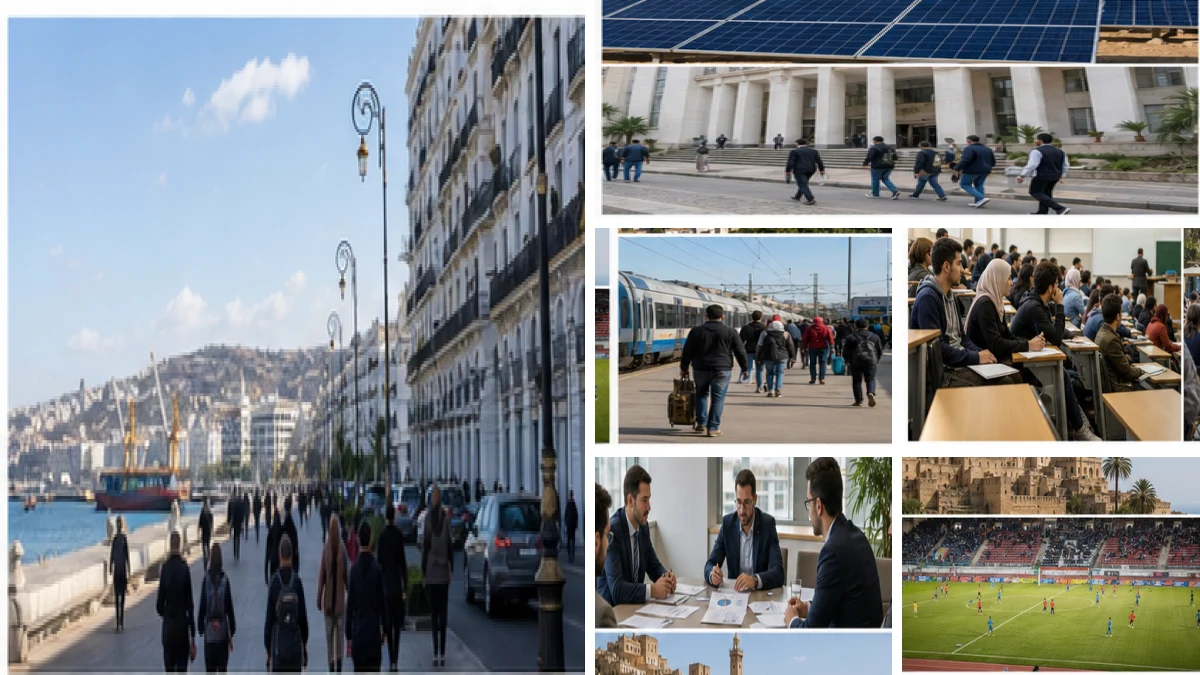
Government reviews land use, call centres and climate commitments
The government meeting chaired by Prime Minister Sifi Ghrieb covered three public-policy files: public projects involving agricultural or forest land, a roadmap for call-centre development in Algeria, and the country's nationally determined climate contribution under the Paris agreement. The confirmed point is executive review, not the adoption of decrees, land reclassification or revised climate targets.
The land-use file sits between public-service needs and the protection of productive or forest space. The call-centre file belongs to the services economy, where employment, training, languages, connectivity and business supervision all matter. The climate item keeps Algeria inside an international reporting framework tied to the file reviewed by the government.
Legislative campaign activity continues
The campaign for the July 2 legislative election continued through meetings, programme presentations and appeals for participation. This digest treats the item as civic news: it records that public campaigning is active, while avoiding party rankings, turnout forecasts, candidate scorecards or the repetition of slogans as facts.
At this stage, local, social and economic themes are being brought before voters in different wilayas. The article separates the existence of campaign activity from promises that will need later checking through programmes, decisions or measurable outcomes.
Police announce a large financial-crime case in the tobacco sector
Police announced the dismantling of an alleged criminal network linked to a tobacco trading and distribution company. Reported losses are close to 1,000 billion centimes, and several people were detained as part of the case. The wording remains legal and cautious: suspects are not described as convicted.
The public angle is economic accountability. The digest records the police announcement, the financial order of magnitude and reported asset seizures in Algeria and Spain, while avoiding identities, political interpretations and untested legal conclusions.
SNTF opens a locomotive acquisition process
The national railway operator opened a national and international tender process to strengthen its locomotive fleet. Economic reporting describes the possible purchase of more than one hundred diesel-electric locomotives for freight and passenger services, but the verified stage is procurement, not award. No supplier, financing package, delivery date or final quantity is presented as settled.
Rail traction capacity affects freight reliability, passenger services, maintenance planning and logistics. The article places the tender in transport and economy, while keeping the limit clear: a procurement process signals need and intent, but it does not by itself prove delivery or immediate service improvement.
Algeria condemns attacks targeting Jordan, Kuwait and Bahrain
Algeria condemned attacks that targeted Jordan, Kuwait and Bahrain. The item is written as a diplomatic position, not an operational account. The public record here is Algeria's diplomatic condemnation, rather than an operational account of the attacks.
Attaf receives the head of an international mediation body
Ahmed Attaf, Minister of State and Foreign Minister, received Teresa Cheng, secretary-general of the International Organization for Mediation, during her official visit to Algeria. The digest reports the meeting and the institutional level of the exchange without claiming a new mandate, agreement or mediation process.
European Music Festival scheduled in Algiers
The 26th European Music Festival in Algeria is scheduled from June 13 to 16 at the Algerian National Theatre Mahieddine-Bachtarzi. The announced frame includes music and dance performances. The dated venue and music-and-dance format are the central public elements of the event.
Algeria beat Bolivia 4-0 in Kansas City
The sport item confirms Algeria's 4-0 win over Bolivia in Kansas City. The match was the national team's final preparation test before its opening World Cup fixture. The score was accepted after a production check against a federation match report and an international result record.
The digest does not turn a friendly victory into a tournament guarantee. The solid public facts are the opponent, the score and the role of the match as a final competitive rehearsal.
Baccalaureate session reaches its final scheduled day
The 2026 baccalaureate reaches the final scheduled day of its June 7-11 examination calendar. The item matters because the exam mobilises candidates, families, centres, supervisors and public services. The stable public point is the calendar milestone for candidates, families, examination centres and education teams.
Additional factual context
The government item links three files that all require administrative precision. Public projects on sensitive land need a balance between facilities and land protection; call-centre development depends on training, digital connectivity, languages and business supervision; climate reporting requires careful wording because an international contribution file is not the same as a newly published target.
The election and justice items sit in different public registers. Campaign meetings and participation appeals are public facts, while electoral strength and future turnout remain separate questions. The tobacco-sector case is large in financial terms, yet legal responsibility has to be established through investigation and courts. The article records the case inside that legal frame.
The transport, culture, education and sport items add practical detail to the day. SNTF's tender matters because locomotives affect freight, passenger reliability and maintenance. The European Music Festival gives Algiers a dated cultural appointment. The baccalaureate item marks the end of a planned national exam schedule. Algeria's 4-0 win over Bolivia is a confirmed score, and the digest keeps it inside the context of a preparation match.
Detailed item notes
The government land file is especially sensitive because public projects can involve schools, hospitals, roads or administrative facilities, while agricultural and forest land carry long-term value. A responsible summary therefore names the conflict of uses without saying that one side has already prevailed. The call-centre roadmap also needs a practical reading: such activity can support employment and outsourcing only if staffing, data handling, connectivity and service quality are organised. The climate contribution file is treated as a policy-tracking item, not as a new climate plan.
For the SNTF tender, the practical consequence is potential future capacity, not immediate movement on the network. Locomotives affect whether freight can move regularly, whether passenger services can keep schedules and whether maintenance reserves are sufficient. The digest does not state that the fleet has already been renewed. For the education item, the final scheduled baccalaureate day is a calendar milestone; the next reliable public facts will concern official examination administration, marking and later results.
Sector-by-sector factual detail
The June 11 file links public administration, politics, economic accountability, transport, diplomacy, culture, education and sport. The government item remains centred on three files reviewed at executive level, while the legislative campaign item records visible field activity before the July 2 vote. In the economy, the tobacco-sector case is treated as a police-announced financial investigation, and the SNTF tender marks a procedural step for railway equipment rather than an awarded contract. The two diplomatic items are separate: one is Algeria’s condemnation of attacks targeting three Arab countries, the other is a multilateral contact with the International Organization for Mediation. The public calendar is rounded out by a dated European Music Festival in Algiers, the final scheduled day of the baccalaureate session and the national football team’s win over Bolivia.