


Algeria’s UNESCO and World Heritage story is not a single monument or a simple travel checklist. It reaches from the Hammadid ruins of the central highlands to the rock art and sandstone landscapes of Tassili n’Ajjer, from Roman cities such as Djémila, Tipasa and Timgad to the living urban fabric of the Kasbah of Algiers and the desert architecture of the M’Zab Valley. Together, these places show how Algeria connects Mediterranean, Saharan, Amazigh, Arab-Islamic, Roman, Ottoman and modern heritage in one national landscape.
This guide is a practical cultural overview for travelers and readers researching Algeria’s UNESCO-listed heritage. It explains what each World Heritage property is known for, why the sites matter, and how to approach them respectfully. It does not replace current local visitor information: opening days, ticketing, guide requirements, road conditions and conservation rules should always be checked with official or local sources close to the date of travel.
Algeria’s UNESCO heritage at a glance
UNESCO World Heritage status is reserved for places considered to have Outstanding Universal Value. In Algeria, the listed properties cover several very different kinds of heritage: archaeological ruins, historic urban settlements, desert cultural landscapes, prehistoric rock art, Roman town planning, Islamic architecture and living communities. That range is one reason Algeria is such a strong heritage destination. A visitor can study antiquity, medieval North Africa, Saharan adaptation and Mediterranean city life without leaving the country.
The seven World Heritage properties usually associated with Algeria are Al Qal’a of Beni Hammad, Tassili n’Ajjer, M’Zab Valley, Djémila, Tipasa, Timgad and the Kasbah of Algiers. Each deserves its own detailed page, but a single hub helps travelers understand the wider pattern. These places should not be treated as interchangeable ruins. Some are archaeological parks, some are living urban environments, and some are vast protected landscapes where cultural and natural values are closely connected.
UNESCO’s descriptions are the safest foundation for understanding the sites. Travel blogs may be useful for impressions, but they can become outdated quickly, especially for access, conservation rules and local conditions. ALG DZ therefore separates heritage facts from travel logistics: the cultural importance of a site can be explained here, while practical details such as opening times and tickets must be checked again before publication of any itinerary or visit plan.
Al Qal’a of Beni Hammad
Al Qal’a of Beni Hammad is an archaeological site in a mountain setting north-east of M’Sila. UNESCO describes it as a remarkable ensemble of preserved ruins founded at the beginning of the 11th century by Hammad, son of Bologhine, the founder of Algiers. It later became the first capital of the Hammadid emirs before being abandoned in 1090 under the threat of Hilalian invasion.
The site matters because it preserves evidence of a powerful medieval North African civilization. Within its fortified walls were monumental remains including the Great Mosque and its minaret, as well as palace structures. UNESCO presents the Qal’a as one of the most precisely dated monumental complexes of Islamic civilization and as a witness to Hammadid refinement, architecture and palatial culture.
For visitors, the important point is to read the landscape as more than stone remains. Altitude, defensive position, urban planning, religious architecture and political history all work together. A responsible visit avoids climbing on fragile structures, removing fragments or treating the place as an abandoned playground. The site is part of Algeria’s medieval memory and should be approached with the same respect as a museum collection.
Tassili n’Ajjer
Tassili n’Ajjer is one of Algeria’s most internationally recognized heritage landscapes. UNESCO describes it as a vast plateau in south-eastern Algeria, near the borders with Libya, Niger and Mali, covering about 72,000 square kilometres. It is famous for an exceptional density of paintings and engravings, prehistoric vestiges and eroded sandstone formations that create the impression of a “rock forest.”
The rock art is central to the site’s significance. UNESCO notes that more than 15,000 drawings and engravings testify to climate change, wildlife migration and the evolution of human life on the edge of the Sahara. Images include water-dependent species and animals no longer present in the region, making Tassili not only an artistic archive but also a record of environmental transformation.
Tassili is also a natural and geological landscape of great power. Its sandstone formations, desert light and scale attract travelers, photographers and researchers, but this is not a casual open-access attraction. UNESCO’s own management notes emphasize vulnerability to climate phenomena and visitor damage, and tourism is strictly controlled with official guiding. Visitors should never touch rock art, mark stone surfaces, remove material, fly drones without authorization or publish sensitive site details that could encourage damage.
M’Zab Valley
The M’Zab Valley, about 600 kilometres south of Algiers, is a living desert settlement system. UNESCO identifies five ksour, or fortified villages: El Atteuf, Bounoura, Melika, Ghardaïa and Beni Isguen, with palm groves that form part of the wider cultural landscape. Founded between the 11th and 14th centuries, the ensemble preserves a distinctive way of life, building technique and social organization adapted to a semi-desert environment.
UNESCO highlights the valley’s architecture and town planning: compact settlements, defensive walls, mosques whose minarets also functioned as watchtowers, and houses organized in a way that reflects privacy, family structure and community order. The site is also linked to water management and palm-grove life, showing how human settlement adapted to limited resources.
For travelers, the M’Zab Valley demands cultural sensitivity. These are not empty monuments; they are living communities with religious, social and domestic boundaries. Dress, photography, guiding, access to certain quarters and behavior in public spaces should be handled with care. A respectful visitor understands that the valley’s value lies not only in architecture but also in continuity, restraint and local dignity.
Djémila
Djémila, known in antiquity as Cuicul, is one of Algeria’s major Roman archaeological sites. UNESCO places it north-east of Sétif and describes it as an ancient Roman colony founded during the reign of Nerva. The town occupied a mountain position and adapted Roman urban planning to a challenging site of rocky spurs and mountain torrents.
Its importance comes from both urban form and surviving monuments. UNESCO refers to the forum, senate, temples, market, civil basilica, theatre, baths and Christian buildings, as well as an impressive collection of mosaic pavements. The site shows how Roman architecture in North Africa could follow classical principles while adapting to local terrain and later religious change.
Djémila is an excellent place for travelers who want to see more than isolated ruins. Streets, public buildings, religious spaces and domestic decoration help visitors imagine the structure of a Roman city. Because mosaics and archaeological walls are fragile, visitors should stay on permitted paths and avoid stepping on or touching protected surfaces.
Tipasa
Tipasa is a coastal World Heritage property west of Algiers. UNESCO describes it as a serial property made up of three sites: two archaeological parks near the modern urban complex and the Royal Mauritanian Mausoleum. Its value comes from the contact between indigenous civilizations and waves of colonization from the Punic and Roman periods through late antiquity.
The site is especially rich because it brings together sea, archaeology and layered history. UNESCO notes Punic necropolises, Roman buildings, Christian religious structures, mosaics and funerary architecture. Tipasa therefore helps visitors understand the Mediterranean character of Algeria’s ancient past: maritime exchange, local traditions, Roman urbanism and later Christian presence all appear in one landscape.
Tipasa is also vulnerable to urban pressure, vegetation, uncontrolled access and tourism impacts. Travelers should not assume that a famous coastal ruin can absorb careless behavior. Respect barriers, avoid walking over archaeological remains, do not remove stones or pottery fragments, and be cautious when using older visitor information that may no longer reflect conservation rules.
Timgad
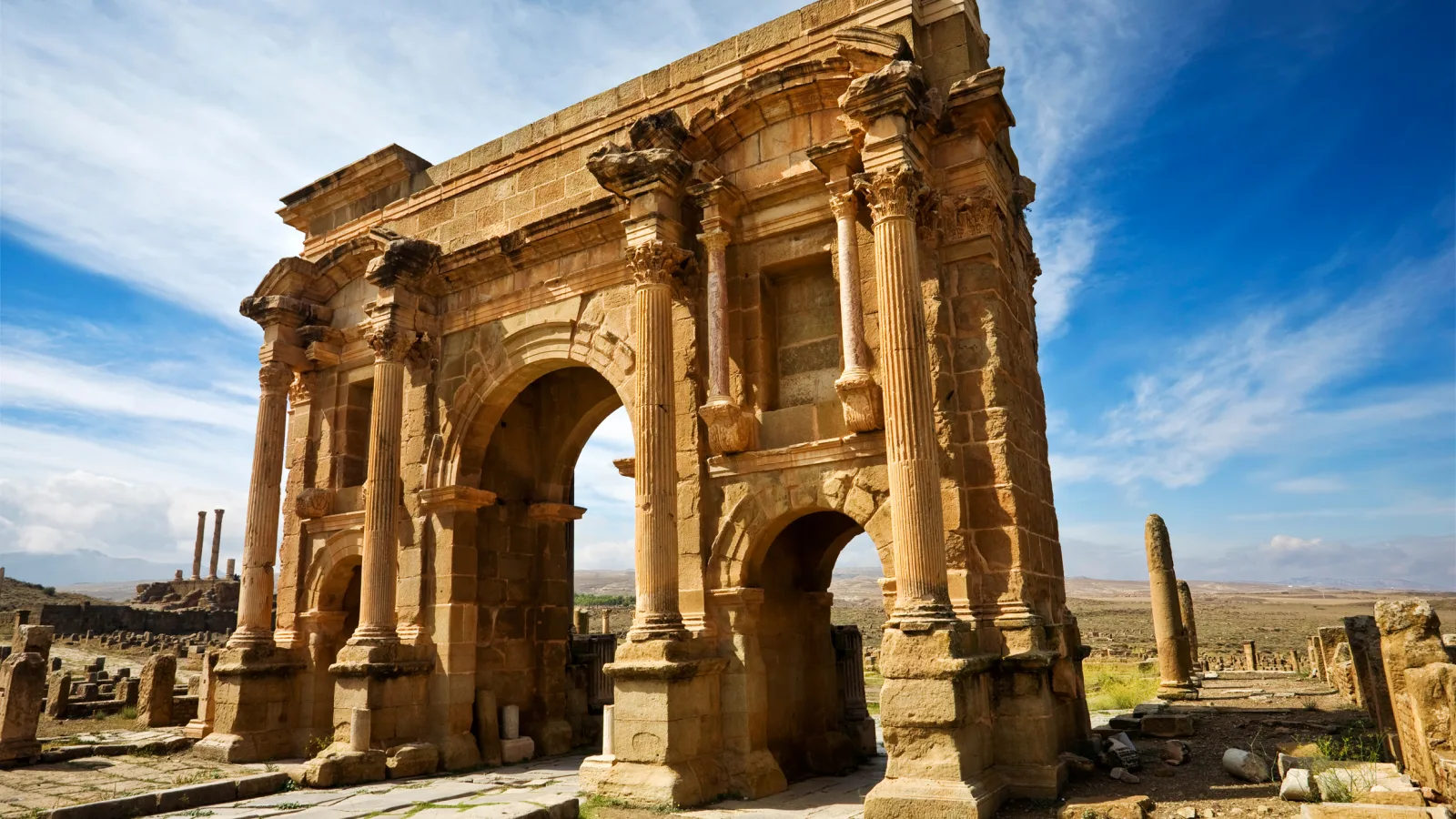
Timgad, the ancient Thamugadi, is one of the clearest examples of Roman urban planning in North Africa. UNESCO describes it as a Roman military colony founded by Trajan in 100 AD, located north of the Aurès massif. Its plan, laid out with great precision, illustrates Roman town planning at its height.
The site is known for its grid layout, stone-paved streets, public buildings, baths, temples, markets and the celebrated Trajan Arch. UNESCO also notes the city’s later expansion, private residences, mosaics, Christian period and Byzantine reuse. Timgad allows visitors to see the logic of a planned Roman town rather than only individual monuments.
For a traveler, Timgad rewards slow observation. The grid, gates, forum area, baths, theatre and arch make more sense when read as a complete urban system. It is also a fragile archaeological place. Climbing on walls, taking shortcuts through ruins, littering or using vehicles in sensitive zones damages the very qualities people come to see.
Kasbah of Algiers
The Kasbah of Algiers is different from Algeria’s archaeological parks because it is a living historic city. UNESCO describes it as an outstanding example of a historic Maghreb city with influence on town planning in the western Mediterranean and sub-Saharan Africa. The site is located on the Mediterranean coast and preserves layers of history, including Phoenician, Zirid, Ottoman and later urban development.
UNESCO emphasizes traditional houses, palaces, hammams, mosques, souks and a dense urban form adapted to a steep and uneven site. It also notes that tens of thousands of people live within this environment, which means visitors must behave as guests in a residential and cultural space, not as spectators in an open-air museum.
The Kasbah is beautiful, complex and vulnerable. Restoration, fire risk, earthquakes, overcrowding and unauthorized interventions are part of the conservation picture. Travelers should use knowledgeable local guidance where appropriate, avoid intrusive photography, respect private homes and religious spaces, and understand that preservation depends on residents as much as monuments.
How to plan heritage travel responsibly
UNESCO status can make a place famous, but fame should not turn heritage into a checklist. A better approach is to choose a region and understand what type of heritage you are visiting. Roman sites such as Djémila, Tipasa and Timgad require attention to archaeological protection. Living sites such as the Kasbah and the M’Zab Valley require respect for residents, privacy and local social codes. Saharan cultural landscapes such as Tassili n’Ajjer require official guidance, environmental caution and strict protection of rock art.
Before visiting, check current access, local guidance, seasonal weather, road conditions and conservation restrictions. Avoid relying on old posts for opening hours or ticket prices. In desert regions, planning must also include water, heat, distance, communications, fuel and guide arrangements. In urban heritage areas, plan for walking, modest dress in conservative contexts, and patience with narrow streets or restoration works.
Responsible heritage travel also means paying attention to language. Do not describe Algeria’s UNESCO sites as “lost,” “empty” or “forgotten” simply because they are ancient or less visited by international tourists. Many are connected to living communities, national identity, scholarship and ongoing conservation work. Accurate language protects dignity as well as facts.
World Heritage and intangible heritage
UNESCO also works with intangible cultural heritage: practices, knowledge, skills, rituals, music, crafts and food traditions that communities recognize as part of their living heritage. Algeria’s UNESCO Intangible Cultural Heritage profile records multiple inscriptions, including the shared Maghreb element for the knowledge, know-how and practices pertaining to the production and consumption of couscous. This matters because Algeria’s heritage is not only stone, mosaics and ancient walls; it is also sound, taste, craft, memory and practice.
Travelers should avoid mixing categories carelessly. A World Heritage property, an intangible heritage element and a national monument are not the same thing. Each has its own system of recognition and protection. On ALG DZ, this page introduces the connection, while future fulfilled pages can explain individual practices or sites in more detail once they appear in the existing backlog and have a proper source base.
Quick comparison for travelers
- Best for Roman urban planning: Timgad, Djémila and Tipasa.
- Best for Saharan rock art and geological landscape: Tassili n’Ajjer.
- Best for medieval Islamic urban history: Al Qal’a of Beni Hammad.
- Best for living desert architecture: M’Zab Valley.
- Best for historic urban life in the capital: Kasbah of Algiers.
- Most sensitive visitor behavior: living communities, rock-art areas and fragile archaeological surfaces.