


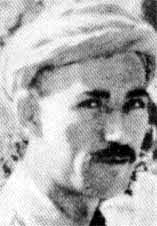
 By his real name Aît Hamouda, he was born on October 31, 1927, in the village of Tassaft Aguemoun, in Djurdjura. Coming from a poor family, he had a particularly difficult childhood and adolescence during which his aversion to colonialism took shape.
This is how he joined all the nationalist initiatives in which he was able to participate. In 1950, he joined the MTLD (Movement for the Triumph of Democratic Liberties.) His activities brought him to the notice of the colonial police, who arrested him the same year and imposed a stay ban on him in Algiers.
Several times checked, arrested or worried by the authorities, he decided, in 1954, to go to France, where he resumed contact with the nationalist movement. At the end of the year, he returned to the country and was among the first to respond to the Appeal of November 1, 1954. His political background and his knowledge of the region meant that he was entrusted with great responsibilities in the organization of the armed struggle in Kabylia. After occupying several positions, he was designated as commander of the area which would subsequently become wilaya III.
In a few months, he found himself at the head of a powerful military organization which multiplies operations against the French army and the colonial administration. Very quickly, the commandos led by Amirouche acquired a great reputation and, although they were insufficiently equipped, they were recognized for their great efficiency and exceptional mobility.
All of this earned Amirouche the responsibility of protecting the Soummam Congress (August 20, 1956.) Part of the units he commanded positioned themselves around the location of the congress (Ifri, commune of Ighzer-Amokrane) while the other part engaged in multiple skirmishes with the French army to create a diversion.
During this time, Amirouche participated in the congress and contributed with the other leaders of the Revolution to define the political, administrative and military structures of the country. Once the congress was over, he returned to his headquarters and began to organize his units according to the recommendations adopted.
The fighting is resuming with a vengeance in wilaya III and, despite large-scale sweeps and the mobilization of colossal resources by the French army, each month that passes leaves an impressive record of ambushes, attacks and various operations.
Amirouche and his units are reported in several places at once! But there is no shortage of difficulties: the French army deploys thousands of men; dozens of villages were razed, cutting off in certain areas the mujahideen from active support of the populations then deported; the ammunition is running out...
Amirouche then decides, with Haouès, head of wilaya VI, to go to Tunis to consult with other leaders of the Revolution. In March 1959, he went south to meet Haouès, but, spotted by the enemy, the katiba which escorted him had to confront three regiments of paratroopers.
The combat on open ground is too unequal. Amirouche and a few men managed to leave their adversary behind. A week later, on March 28, they met Haouès south of Bou-Saada and headed together towards Tunisia. But the group is then attacked by units of the colonialist army: 2,500 French soldiers against around fifty mujahideen.
The battle quickly turns into a massacre and Amirouche falls alongside Haouès. The National Liberation Army thus lost two of its most brilliant officers but the fighting did not stop and the wilayates they commanded continued to deal terrible blows to the enemy.